Zimbabwe: Helicopter Donations and Diamond Fraud Affect Party Politics

By Hannah Stewart
Impunity Watch Reporter, Africa

HARARE, Zimbabwe — The last Zimbabwean elections, held in 2008, were marred by violence and allegations of rigged voting.  With presidential elections on the horizon, Zimbabwe has had an interesting week between diamonds and helicopters.  As South Africa prepared to ship a surplus of military helicopters to Zimbabwe, President Robert Mugabe’s party called for the investigation of multiple provincial leaders’ diamond fraud.
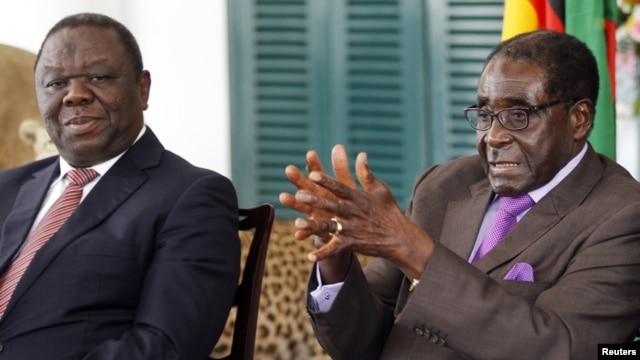
Zimbabwean President Robert Mugabe (R) and Prime Minister Morgan Tsvangirai. (Photo Courtesy of Voice of America)

The announcement that the South African military had agreed to donate its surplus of aging French-designed Alouette helicopters to Zimbabwe for “imminent delivery” was met with protests from regional civic campaign groups.

AfriForum, a human rights group, protested South Africa’s military donations.  And today a court in South Africa has temporarily halted a delivery of helicopters to the Zimbabwean military.  High Court Judge N. B. Tuchten prohibited South Africa’s government from exporting any Alouette helicopters or spares to Zimbabwe until a full hearing could be held on February 19.

Willie Spies, AfriForum’s legal spokesperson, was confident that the order would be upheld next month. “We know that Zimbabwe has got a record of human rights abuses,” Mr. Spies said.  Moreover he stated, “We know what happened during 2008 with the second round presidential elections.  We know the Zimbabwe Defense Forces are not a neutral defense force committed to defending the Zimbabwean state.”

Furthermore, Mr. Spies said, “[The military is] an aggressive force that’s been used against the people of Zimbabwe to suppress the opposition.”

Earlier on Friday, South Africa’s Mail and Guardian newspaper reported that it had seen confidential minutes of a meeting held two months ago between the defense chiefs of South Africa and Zimbabwe detailing the “disposal of Alouette helicopters and spares”.  South Africa’s defense department told the paper the donation was part of an agreement that dated back to 1997.

Coinciding with the controversy surrounding South Africa’s military donation are Mugabe’s efforts to “clean up” his party image.  President Robert Mugabe’s ZANU-PF party launched an investigation into alleged diamond fraud involving five of its officials, who have exposed the party’s control of the Chiadzwa diamond fields.  The case involves more than $750,000 that the five party members allegedly “swindled” from mining companies for ZANU PF activities.  The money was then reportedly used in part to finance the officials’ personal lives.

It is already widely speculated that ZANU PF has been using the diamonds fields to generate cash for the party.  ZANU-PF has endorsed Mugabe, 88, as its candidate for the presidential vote.  The coming election is expected to be hotly contested as it is widely believed that Mugabe’s policies ruined Zimbabwe’s economy.

For more information, please see:

All Africa – Zimbabwe: Zanu-PF Investigating Party Diamond Fraud – 18 January 2013

BBC – South Africa Court Halts Zimbabwe Helicopter Donation – 25 January 2013

Reuters – Zimbabwe Order Diamond Fraud Probe as Elections Looms – 25 January 2013

The Washington Post – Campaigners Try to Stop Zimbabwe Helicopter Gunship Delivery from Neighboring South Africa – 25 January 2013

Egypt Celebrates Anniversary of Revolution with More Protests

By Justin Dorman
Impunity Watch Reporter, Middle East

CAIRO, Egypt – Exactly two years ago, on January 25th, the Egyptians underwent a revolution to oust the military dictatorship of Hosni Mubarak. On the second anniversary of this revolution, thousands of Egyptians have taken to the streets to demonstrate against the country’s Islamist president, Mohamed Morsi.

Thousands of Egyptians rallied in the streets to protest President Morsi on the anniversary of the Mubarak uprisings. (Photo Courtesy of Al Arabiya)

Demonstrations became clashes with stone-throwing, gunfire, and tear gas between protestors and police in Cairo, Alexandria, Suez, and Port Said. Two state-owned buildings, one in Damietta and another in Kafr el-Sheikh, and one office used by the Islamist Muslim Brotherhood were also set ablaze by arsonists.

So far nine individuals have been killed. Seven of which were protestors and the other two were police. As reports are updated, the numbers continue to change, however, at the moment approximately two-hundred and eighty civilians have been injured, while another fifty-five security personnel have been hurt.

Many of the protestors present at these rallies were not shy to speak ill of their current president, Mohamed Morsi. Senior member of the Free Egyptians, Karim Abadir, stated that, “there’s no military dictatorship any more, but there are the beginnings of a theocratic one.”

Hisham Abdel-Latif, a protestor from the Cairene suburbs remarked that Egyptians are, “now ruled by a gang that is exactly the same as the Mubarak gang, except they now have beards.”

Protestor Moustapha Magdi said, “I’m here to get rid of Morsi. . .First Mubarak, then Tantawi, now Morsi. We are only ruled by bastards.”

Others chanted the mantra of 2011’s revolution, yelling as they marched, “the people want to bring down the regime,” and “Leave! Leave! Leave!”

The main complaints against Morsi are that he is only concerned with instituting Islamic law and that he has failed to address Egypt’s struggling infrastructure.

Not all of Egypt feels this way. A recent poll revealed that Morsi boasted an approval rating of sixty-three  percent. There are also other individuals who believe that Morsi has not been given a chance.

The Muslim Brotherhood does not believe that these violent protests are beneficial to the fragile country. Additionally, the Brotherhood notes that its rivals are refusing to properly adhere to the results of the free elections of the new democracy that placed the Brotherhood at the helm of the country.

Morsi, himself, took to Twitter to criticize the stone throwing protestors. He tweeted that, “the ugly violence aims at tainting the civilized nature of Egypt’s revolution. . . I call on all citizens to hold onto the noble principles of the Egyptian revolution to peacefully and freely express their views.”

For further information, please see:

Ahram – Live Updates 2: Nine dead on Egypt’s Uprising Anniversary as Morsi Offers Condolences – 25 January 2013

Arabiya News – Egypt Protesters Attack Official Buildings, Torch Brotherhoods HQ – 25 January 2013

Al Bawaba – Clashes Across Egypt on Second Anniversary of Revolution – 25 January 2013

Guardian – Violence Flares in Egypt on Anniversary of Revolution – 25 January 2013

Reuters – Five die in Egypt Violence on Anniversary of Uprising – 25 January 2013

Britain Introduces Law To Legalize Same Sex Marriage

By Alexandra Sandacz
Impunity Watch Reporter, Europe

LONDON, United Kingdom – On Friday, the British government created a bill to legalize same-sex marriage. The Marriage Bill extends marriage to gay couples; however, also prevents clergy in the Church of England from having to carry out the ceremonies.

British government will vote next month to legal same-sex marriage. (Photo Courtesy of Irish Examiner).

Since 2005, gay couples in Britain were permitted to form civil partnerships, which give them the same legal protection, adoption and inheritance rights as heterosexual married partners. However, their partnerships lacked the label of marriage.

The new bill will allow couples who previously entered into civil partnerships to convert their relationship into a marriage, while also including specific provisions that intend to satisfy religious opponents of same-sex unions while simultaneously stopping religious leaders from criticizing the bill.

Equalities Minister, Maria Miller, stated, “We feel that marriage is a good thing and we should be supporting more couples to marry and that is exactly what the proposals being brought forward today do.”

However, she continued, “We are trying to make sure that there are the protections there for churches who feel that this isn’t appropriate for their particular beliefs. We know that there are churches who do want to take part in same-sex marriages, so we have made sure that there are provisions there so they can.”

Additionally, Maria Miller rejected claims that teachers could face disciplinary action if they refuse to “promote” gay marriage in schools. She says, “Teachers are able to, and entitled to, express their views about same-sex marriage and there is no requirement at all for them to promote it. But obviously we wouldn’t expect teachers to be offensive or discriminate in any way about anything.”

She concluded, “Of absolutely paramount importance to me is that when it comes to civil society, we should be treating people equally and fairly and the measures we are putting forward today are doing that.”

The Bishop of Leicester, the Right Reverend Tim Stevens, stated his opposition; marriage should continue to be “a union between one man and one woman. It is a social institution that predates both church and state and has been part of the glue that has bound countless successive societies together.” The “absence of an overwhelming public consensus for change ought at least to give pause for thought.”

While some traditionalist Conservative lawmakers say they will vote against it, conservative Prime Minister David Cameron, many members of his Cabinet, and most Liberal Democrat and Labour lawmakers support the new marriage bill.

The first debate and vote are scheduled for Feb 5.

For further information, please see:

Associated Press – Britain Introduces Same-Sex Marriage Bill – 25 January 2013

BBC News – Gay marriages: Government Publishes Legislation – 25 January 2013

Irish Examiner – British Govt Publishes Gay Marriage Bill – 25 January 2013

USA Today – Britain Considers Same-Sex Marriage Bill – 25 January 2013

Change of Rape Law in Morocco

By Justin Dorman
Impunity Watch Reporter, Middle East

RABAT, Morocco –There once was a time in Morocco where a rapist could avoid any charges against him, if he were to marry his victim. The times, they are changing, as is Moroccan rape law.

Amina al-Filali’s suicide triggered protests that would eventually lead to the amending of Article 475. (Photo Courtesy of Al Jazeera)

The tradition that safeguarded the rapists was codified in Article 475 of the penal code which stated that those who were found to have “corrupted” or “kidnapped” a minor could go free if they married the victim. This practice was encouraged by the courts of Morocco because of the antediluvian judgment that a woman’s loss of virginity out-of-wedlock would tarnish the respect of the family.

The strict translation of Article 475 from French reads, “When a minor removed or diverted married her captor, the latter cannot be prosecuted on the complaint of persons entitled to apply for annulment of marriage and cannot be sentenced until after the cancellation of marriage has been pronounced.”

This effort to change the law comes approximately a year after sixteen-year-old Amina al-Filali killed herself with rat poison after she was forced into an abusive marriage with Moustapha Fellak, whom had previously raped her.

Women’s rights activists are happy to see reform in this law, but are still calling for many more changes to be made. President of the Democratic League for Women’s Rights, Fouzia Assouli, explained that, “the code only penalizes violence against women from a moral standpoint, ‘and not because it is just violence’.”

For instance, the new article that was just proposed carries a twenty-year penalty for consensual sex that follows the corruption of a minor that results in “deflowering,” but carries only a ten-year penalty if no “deflowering” occurs. Similarly, there are no penalties for conjugal or marital rape, whereas nearly fifty percent of all attacks against women take place between married couples.

Prime Minister Abdelilah Benkirane defends his country and its practices by insisting that the change in law is more a formality than a dramatic departure from current practices. He claims that, “in five-hundred and fifty cases of corruption of minors between 2009 and 2010, only seven were married under Article 475 of the penal code, the rest were pursued by justice.”

Before the amended article becomes law, it must be passed by both houses of parliament. Parliament has been slow in the past at passing laws on women’s rights, as a law to combat violence against women has been neglected by parliament for the past eight years.

For further information, please see:

Al Jazeera – Morocco to Change Rape Marriage law – 24 January 2013

Feminist – Morocco to Change Rape law that Forces Marriage – 24 January 2013

Jurist – Morocco to Change Rape law Allowing Marriage – 24 January 2013

National Sexual Violence Resource Center – Morocco Plan to Change Rape Marriage law – 23 January 2013

Masked Serbian Police Remove Albanian Rebel Memorial

By Madeline Schiesser
Impunity Watch Reporter, Europe

PRESEVO, Serbia – By order of the Serbian government, 200 heavily armed special police officers, their faces covered, removed a memorial from the ethnically mixed Presevo Valley that bore the names of 27 ethnic Albanian guerrillas killed during a 2000 insurgency in the region.

An armed officer stands by while the Presevo war memorial is loaded into a truck. (Photo Courtesy of France24)

During and after the Kosovo war (1998-1999, with insurgency in the southern Serbian regions of Presevo, Medvedja, and Bujanovac continuing though 2001), Albanian rebels fought against Serbia.  The Liberation Army of Presevo, Medvedja and Bujanovac (LAPMB) hoped to free these regions from Serbian control and unite with Kosovo.  To Serbian authority, these rebels were seen as terrorists.  However, to ethnic Albanians, they were heroes.  However, the LAPMB laid down their arms under a NATO-brokered peace deal in 2001 in which Serbia agreed to greater rights and economic opportunity for the impoverished South.  Such progress has been slow.  Furthermore, Serbia has never recognized Kosovo’s unilateral declaration of independence in 2008, and still considers it to be a southern province.

The Presevo Valley memorial held particular significance to the Albanian community.  Although there are other memorials in the area, the two-meter (six-foot) rectangular stone monument stood with pride in Presevo’s central square, in front of the local council building.  The slab bore the LAMPB insignia and the inscribed names of the 27 guerillas who died in the insurgency.  It had been erected in December by the primarily ethnic Albanian local council, and local officials refused an order from the Serbian government to remove it by Thursday at 11pm.

In January, several attempts were made to reach a resolution between the government and Presevo authorities, but all were rejected by the Presevo city Hall

Then on Sunday January 20, beginning overnight and backed by armored personnel carriers, 200 heavily armed, masked police officers moved in on Presevo and removed their war memorial.

Declaring that the monument had been erected illegally, Prime Minister Ivica Dacic said, “We showed enough patience. Our clear and strong message is that the law should be respected and that no one is stronger than the state.” He further stated that “no one has the right to humiliate Serbia.”

The removal came only days after the European Union had praised Serbia for making progress in normalizing relations with Kosovo.  Kosovo warned that the removal could hurt EU-mediated talks aimed at such normalizing.

The head of the Albanian National Council in Presevo, Galip Beqiri, called the removal “an unacceptable act of vandalism” and said that plans to launch protests were being discussed.

Accordingly, at least 2,000 ethnic Albanians in Presevo took to the streets on Monday in protest.  They waved Albanian flags and banners that read “Stop discrimination” and “Europe, open your eyes”.

Although both the Organization for Security and Cooperation in Europe (OSCE) and the United Nations have appealed for calm, several acts of vandalism were reported in Serb cemeteries in Kosovo.  Furthermore, police reported shots fired near a Serbian memorial for the Kosovo war in the western town of Gorazdevac, as well damage to a World War II monument in the eastern town of Vitina.

Albania and Kosovo, both having majority ethnic-Albanian populations, condemned the memorial removal.  The government of Kosovo, in addition to saying the decision would undermine normalization talks, further said in a statement, “This action by the government of Serbia is another proof that the hate against Albanians that live in the Presevo Valley is still alive.”

For further information, please see:

Al Jazeera – Protests After Serbia Removes Memorial – 21 January 2013

RFE/RL – Albanians Protest Removal Of Presevo Monument – 21 January 2013

France24 – Police Remove Monument to Albanian Rebels in Serbia – 20 January 2013

RFE/RL – Serbia Removes Ethnic Albanian Memorial – 20 January 2013

Returns – Police remove Albanian Rebel Memorial in South Serbia – 20 January 2013