Protesters Clash with Police after Intelligence Official’s Funeral

By Emily Schneider
Impunity Watch Reporter, Middle East

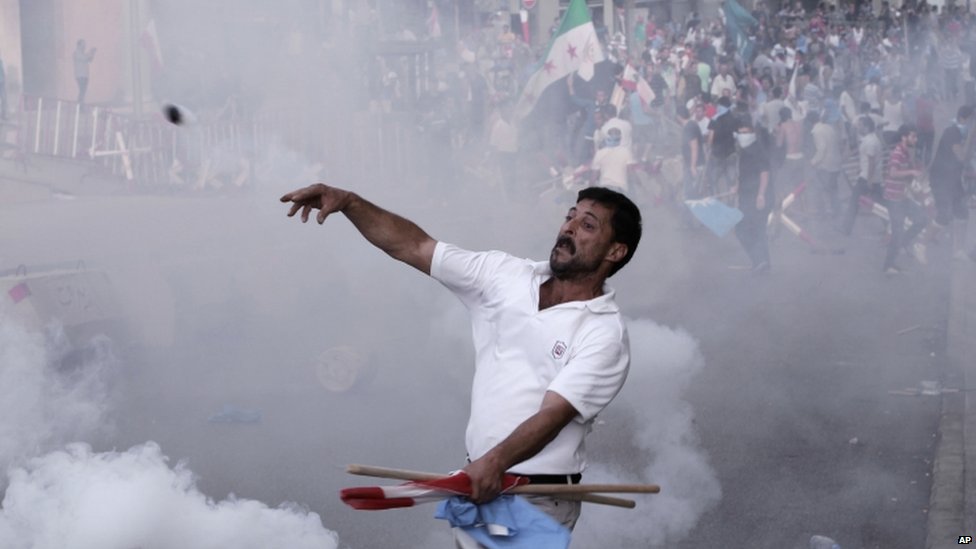
BEIRUT, Lebanon – After the funeral of Brig. Gen. Wissam al-Hassan this Sunday, a throng of protesters took to the streets of Beirut to demonstrate their anti-government rage.  Police fired warning shots and tear gas into the crowd, but dozens of dissidents rushed towards police lines as the mob circled the Prime Minister’s office.

A protester hurls a stone at security forces in Beirut. (Photo courtesy of BBC News)

A large crowd gathered in Beirut’s center square after the funeral to listen to a series of political speeches. At the addresses’ conclusion, the assembled mass began a push towards the prime minster’s office. According to reports, people in the horde were hurling sticks and stones and carrying flags. Protesters chanted for the dismissal of Prime Minister Najib Mikati.

They believed that the Syrian government was responsible for the bomb that caused Hassan’s death. According to CNN, Mikati is a “billionaire supported by Syrian ally Hezbollah.”  Although Syria condemned the blast immediately after it happened, many Lebanese remain skeptical about the neighboring regime’s role in the bombing.  Some saw Hassan’s death as an assassination mirroring those that took place in 2005, when the assassinati0n of then-Prime Minister Rafik Hariri sparked the end of Syria’s occupation of Lebanon. His demise was soon followed by the deaths of several more high-level Lebanese officials, most of whom were known to have anti-Syrian sentiments.

Mikati offered to resign from his position on Saturday. But after President Michel Suleiman asked him to stay place for the good of the nation, he rescinded the offer.

“I have always respected and admired al-Hassan, who has done great things for Lebanon,” Mikati explained to reporters on Saturday. “To hold me personally responsible for the assassination is unfair.”

Other officials disagreed with him, including former Prime Minister Fouad Siniora.  “This government is responsible for the assassination of [a] martyr [al-Hassan] and his companion martyrs, therefore, this government must leave,” Siniora told the crowd on Sunday.

A prominent opposition Minister of Parliament, Ahmad Fatfat, told the BBC’s Newshour programme that the possibility of the situation in Syria spilling into Lebanon is a real danger.

“What Mr. Assad is trying to do now is transfer his problem to all the countries around Syria – to Turkey, to Lebanon, to Iraq, to Jordan, and Lebanon is the most fragile in this story,” Fatfat said.  “And maybe Assad will do what he can to transfer Lebanon into a hell situation so he can think later on that what is going on is a general war in the Middle East and not a revolution in Syria.”

Many attendees of Hassan’s funeral waved the light blue flag of the Sunni-based opposition Future Party, while others carried Lebanon’s national flag.  These visible differences symbolized internal tensions that are mounting within the Lebanese public. Those allied with Sunni coalitions have been critical of what they believe is the Lebanese government’s closeness with the Syrian regime.

“We came for Lebanon’s future to show that we will not be scared,” said one of the mourners.

For further information, please see:

Al-Arabiya – Angry Protestors Storm Lebanese Government HQ, Call for PM to Quit – 21 October 2012

BBC –Beirut funeral for Wissam al-Hassan Followed by Clashes– 21 October 2012

CNN – Violence Erupts After Lebanese Intelligence Chief’s Funeral – 21 October 2012

The Daily Star – Calm Returns After Police, Protestors Clash in Beirut – 21 October 2012

The Daily Star – Siniora Demands Cabinet Resign at Hassan’s Funeral – 21 October 2012

Rape by US Servicemen of an Okinawan Woman Exacerbates Relations

By Karen Diep
Impunity Watch Reporter, Asia

TOKYO, Japan – On Tuesday, Japanese authorities arrested two United States sailors for allegedly raping a Japanese woman on the island of Okinawa.

Okinawan Women Protesting. (Photo Courtesy of Huffington Post)

Japan’s Chief Cabinet Secretary, Osamu Fujimura, shared that ministry defense representatives informed United States officials that “the incident is completely unacceptable.”

“[We] have strongly requested measures to increase discipline and prevent things like this from happening again,” said Mr. Fujimura.

“This should never have been allowed to happen,” stated Japan’s Prime Minister, Yoshihiko, to Japanese reporters.

The two sailors were identified as Petty Officer 3rd Class Skyler Dozierwalker and Seaman Christopher Browning of the Fort Worth Naval Air Base in Texas.  Furthermore, according to information relayed to the Huffington Post, the two men were drinking before they purportedly raped her.

United States Ambassador, John Roos, stated that the United States was “extremely concerned by recent allegations of misconduct” by the two servicemen.

“We are committed to cooperating fully with the Japanese authorities in their investigation,” continued Mr. Roos.

On Friday, Lieutenant General Salvatore Angelella apologized in a statement that announced the United States’ plan to impose a curfew.  “I want to personally apologize for the grief and trauma the victim has endured,” shared the lieutenant.

The curfew confines United States military personnel to the base, a personal home, or hotel between 11 p.m. and 5 a.m.  This curfew will affect an estimated fifty thousand servicemen currently stationed in Japan.

It is important to note that the relationship between the United States and Okinawans has already been strained by events in the past.

Last month, more than one hundred thousand gathered to protest the deployment of the Marine Corps Osprey aircraft.  Many Okinawans believe this is adding to the already heavy United States presence in the area.

Furthermore, prior to Tuesday’s attack, in August of this year, a U.S. Marine was arrested for purportedly molesting and assaulting a woman Okinawa’s capital, Naha.

Moreover, in 1992, three United States personnel allegedly gang-raped a twelve-year-old girl on Okinawa.  The event caused the United States to reduce military presence on the island.

The United States currently bases approximately twenty six thousand troops on Okinawa.

For further information, please see:

CNN – U.S. troops in Okinawa on curfew after arrests in rape case – 19 Oct. 2012

New York Times – Curfew is Imposed on the U.S. Military in Japan Amid Rape Inquiries – 19 Oct. 2012

BBC – US troops held over Okinawa alleged rape – 17 Oct. 2012

Huffington Post – Okinawa Military Rape Arrests: Japan Decries U.S. Troops in Sexual Assault Allegations – 17 Oct. 2012

Yemeni Hospitals Becoming Increasingly Unsafe

By Justin Dorman
Impunity Watch Reporter, Middle East

SANA’A, Yemen – Most people who have been shot will check into a hospital to seek treatment and recovery. Rarely ever does one enter a hospital anticipating that he will end up shot. At present day, such is not the case in Yemen as Central Security Forces’ storming of hospitals threatens to shut down hospitals and weaken the overall health care system.

Saleh Amhad Abdullah was selling fruit outside the medical center when he was shot in the head. (Photo Courtesy of Human Rights Watch)

Yemeni security forces have been raiding hospitals and taking alleged militants from their beds to arrest them. These patients have been suspected of being engaged in illegal activities like armed robbery and attacks against state security. While there is no prohibition against hospital patients being lawfully arrested, international law mandates that they retain their rights to health care. When these patients are forcibly removed, not only is international law violated, but the their lives are put at risk.

The raids pose additional dangers to people other than the patients. A recent Central Security Forces attack on al-Naqib Hospital, in search of two alleged militants, left two hospital guards injured after they were beaten with Kalashnikov assault rifles and a gurney. The Central Security Forces also confiscated cell phones from both patients and staff and ripped out the hospital’s telephone landlines. Gunmen connected to the two men the Central Security Forces were seeking, opened fire on the hospital from the outside. A similar raid at MSF Hospital earlier this month led to shootings inside of the hospital when gunmen tried to prevent the arrests of patients. The shootings forced the MSF hospital to evacuate all of its patients and shut down the facility.

“Gunfights in hospitals put patients and medical workers at grave risk and threaten to shut down health care in Aden,” said Letta Tayler, a senior Yemen researcher at Human Rights Watch.

In addition to the incursions themselves, the security forces’ actions of have had other negative implications on hospitals. A few days ago, security forces began shooting live rounds at unarmed anti-government demonstrators in Sana’a. One hospital received more than one hundred injured people and eventually ran out of beds. It tried to transfer the injured to other nearby hospitals, but the checkpoints set up at almost every intersection by security forces made those efforts difficult.

“Sana’a is a very tense place to be at the moment. This was a huge protest that took place…and I think it just completely overwhelmed the security forces,” said Tariq Norman, the chief surgeon at a field hospital in Sana’a.

For further information, please see:

Human Rights Watch – Yemen: Security Forces Raiding Aden Hospitals – 20 October 2012

Al Jazeera – Deadly Fighting Engulfs Yemen Protests – 16 October 2012

Doctors Without Borders – Yemen: MSF Hospital in Aden Shuts Down due to Violence – 7 October 2012

Doctors Without Borders – Yemen: Violence Forces Closure of Hospital – 5 October 2012

Uruguay Senate Votes to Legalize Abortion

By Margaret Janelle R. Hutchinson
Impunity Watch Reporter, South America

MONTEVIDEO, Uruguay – Late last month Uruguay’s Lower House contemplated and passed legislation that would give women the right to an elective abortion during the first 12 weeks of pregnancy, and decriminalize later-term abortions when the mother’s life is at risk or when the fetus is so deformed that it wouldn’t survive after birth.  Wednesday that bill also narrowly passed in the Senate, by a vote of 17 to 14.

Uruguayan senators raise their hands to vote 17 to 14 in favor of a bill to legalize abortions during the first 12 weeks of pregnancy in Montevideo, Oct. 17, 2012. (Photo Courtesy TIMEWorld)

President José Mujica has openly supported the legislation. Alberto Breccia, a top aide to Mr. Mujica, said Wednesday that the president had no plans to veto the bill, almost ensuring that it would become law by early November.

If it does become law, it would be the second of its kind in South America; Guyana allows elective abortion up until the 8th week of pregnancy.

Uruguay is already considered one of the most liberal countries in South America.  It was the first nation to officially separate the state from the Catholic Church in the early 1900’s and President Mujica has also discussed the possibility of legalizing marijuana in the tiny country.

Uruguay may be geographically small, but pro-choice advocates hope this potential law will make a big impact on neighboring nations.  Although there have been many advances in terms of sexual rights in South America – most notably with Brazil and Argentina legalizing same-sex unions in 2004 and 2010, respectively – abortion is extremely divisive.

Just last week the Argentinian Supreme Court issued a ruling granting an abortion to a women rescued from a prostitution ring.  Even though Argentina allows abortion in the case of rape, a lower court judge had blocked the procedure claiming there was no proof of rape.

Véronica Pérez, a political scientist at Montevideo’s University of the Republic says,

“In terms of the reactions and conflicts [abortion and same-sex marriage] provoke in society,” pushing same-sex unions isn’t the same as advocating the legalization of abortion. For same-sex marriage or gay adoption, for some men it’s like ‘that’s OK, I don’t like it much but it doesn’t affect my rights.’ On the other hand, a woman’s decision to interrupt her pregnancy strikes at the core of masculine decision-influencing power.”

Chile, considered the most conservative country in the region, outright bans abortion even in the case of rape.  Chile only legalized divorce in 2004.

This week’s vote was the third time the bill has been introduced in the Uruguayan Parliament and the Senate’s final vote tally of 17 in favor and 14 against shows how divisive the issue remains. A previous bill was approved in 2008, but then-President Tabaré Vázquez vetoed it.

For further information, please see:

The Christian Science Monitor – Uruguay’s Senate approves abortion bill: Will there be a ripple effect? – 19 October 2012

TIMEWorld – Uruguay Diverges From a Continent Where Abortion is Worse Than Rape – 19 October 2012

BBC News – Uruguay legalises abortion – 17 October 2012

The New York Times – Uruguay Senate Approves First-Trimester Abortions – 17 October 2012

The Wall Street Journal – Uruguay Senate Legalizes Abortion – 17 October 2012

Civil Rights Groups Upset over Boston Police’s Spying

By Mark O’Brien
Impunity Watch Reporter, North America

BOSTON, Massachusetts — Civil rights groups criticized the Boston Police Department this week for secret surveillance of activists who are not criminal suspects.

Susan Barney is among the activists included in intelligence reports compiled by the Boston Police Department, which civil rights groups criticize as a federal violation. (Photo Courtesy of The Boston Globe)

On Tuesday, the American Civil Liberties Union of Massachusetts and the National Lawyers Guild of Massachusetts called on the department to stop illegally spying on anti-war groups that have no affiliation with crime or terror.

“This kind of monitoring of political groups is just the kind of subtle interference that threatens to chill legitimate constitutionally protected speech,” the groups said in a letter to Police Commissioner Edward Davis.  “When police surveillance penetrates the internal workings of peaceful organizations, some Bostonians will be less likely to exercise those fundamental rights.”

By Wednesday, the police department issued a statement in response, saying that routine monitoring is not their practice.  But the department admitted that a computer glitch saved some intelligence reports unrelated to crime for longer than they should have been.

“Boston residents should confidently participate in any lawful, peaceful protest or demonstration knowing the Boston Police Department is not monitoring the events without specific information on suspected criminal activity,” the police statement read in part.

Police officials said the computer software problem was fixed last year, but not before 11 intelligence reports were saved for too long.

The civil rights groups sued the department last year.  They said that resulted in materials that showed police officials tracked and kept records on peaceful groups.

Now the groups are calling on Police Commissioner Edward Davis to create an independent auditing system to identify incoming surveillance reports on expressive activity, determine whether they are crime related, and purge anything unrelated to crime within three months.

But that might be too late for protesters named in the reports.  According to the Boston Globe, they were outraged but not surprised to learn that police documented their connections to protest groups.

“It’s appalling,” Susan Barney said in an interview with the Boston Globe.  She was a political activist listed in two reports.

“Money is being spent to harass, spy on, and surveil (sic) the public, instead of being used for education or housing for low-income communities,” she said.

“I don’t like being considered a homeland security threat,” Ridgely Fuller told the Boston Globe.  “I’m like this middle-aged suburban woman who just wants to speak out against injustice and war.”

The police intelligence reports detail how various Boston activist groups operate and who is involved.  Some even go in-depth about some groups’ views on politics and elections.

Civil rights groups said this violates federal regulations.

For further information, please see:

The Boston Globe — Boston Police Accused of Spying on Antiwar Groups — 18 October 2012

The Boston Herald — Civil Rights Groups Criticize Boston Police Department Surveillance — 18 October 2012

New England Cable News — Boston PD Accused of Spying on Anti-War Groups — 18 October 2012

WHDH-TV — Hank Investigates: Secret Police Files — 17 October 2012