15 Year Old Malian Girl Lashed 60 Times for ‘Speaking to Men’

By Ryan Aliman
Impunity Watch Reporter, Africa

 BAMAKO, Mali – A 15 year old girl was publicly whipped 60 times in Timbuktu three days ago for speaking to a person of the opposite sex.

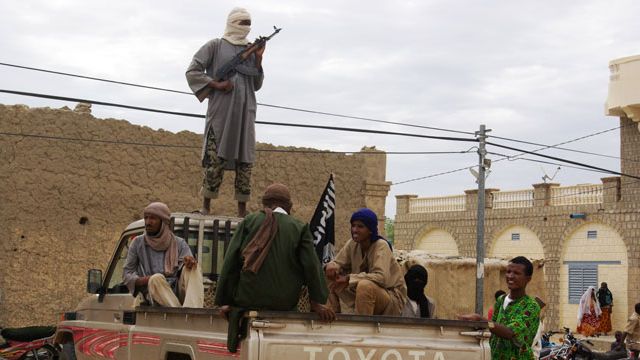
Ansar Dine members stand guard as they prepare to punish a 15 year old girl.(Photo courtesy of Nine News/AAP)

Ansar Dine, the rebel group who currently controls Timbuktu and the rest of Northern Mali, convicted her of speaking to the opposite sex which is allegedly forbidden in Islam. The teenage girl was caught standing alongside a group of men on the street. Ansar Dine members contend that she was warned repeatedly to stop what she was doing, but the girl refused to listen. “The Islamists charged that the girl was warned five times by the Islamist police, but she continued speaking to men on the street. After the hearing, the Islamists gave 60 lashes to the girl,” Ousmane Maiga, a Timbuktu resident relayed to the Associated Press on Monday.

The lashing took place at around 11:00 in the morning local time in front of the police headquarters in downtown Timbuktu. “The population did not turn out in large numbers to attend this flogging,” Maiga added.

This is just one in a series of incidents revealing the harsh and grim state of women in the country. Recent reports have shown that after the enforcement of an extremist version of the Sharia law in Northern Mali, there has been an increasing number of human rights violations particularly aimed at women.

Last Wednesday, after his visit to Mali, U.N. Assistant Secretary-General for Human Rights Ivan Simonovic reported that Islamic extremists are currently compiling a list of unmarried mothers. “It is frightening to hear lists are being compiled of women who are either pregnant or have children and are not married and we do not know what is going to happen to them … We do not know what will happen with those lists, but certainly women were scared that there might be some action taken against them,” he said.

According to local residents Simonovic interviewed during his trip, they feared that women who have had children out of wedlock, or who were unmarried and pregnant, will face severe punishments such as stoning, amputations and executions. Another possible fate for these listed women is to be forced into marriage. After meeting with government officials, community leaders and displaced Malians, Simonovic found out that forced marriages are becoming prevalent in the region. “Wives” are sold for less than $1,000. It is also a common practice among “husbands” to resell their “wives” — a practice Simonovic described as “a smokescreen for enforced prostitution and rapes that are taking place.”


For further information, please see:

Malaysian Digest – Teenage Girl Lashed 60 Times for ‘Speaking to Men in the Street’ – 18 October 2012

Nine News – Mali teen whipped for talking to men on street – 18 October 2012

Huffington Post – Mali Girl Reportedly Whipped For Speaking To Men – 15 October 2012

CNN – Fear grows as Mali extremists compile list of unmarried mothers – 13 October 2012

USA Today – Mali Islamists compiling list of unwed moms – 11 October 2012


Russian President Speaks Out Against Headscarves in Schools

By Alexandra Sandacz
Impunity Watch Reporter, Europe

MOSCOW, Russia – On Thursday, Russian President, Vladimir Putin, publicly opposed Muslim students wearing headscarves in Russian schools. Putin’s statement was in response to a school principal forbidding Muslim girls from wearing headscarves in Russia’s southern Stavropol region.

Russian President, Vladimir Putin, speaks out against headscarves in Russian schools. (Photo Courtesy of Al Arabiya News)

Putin believes Russia is a “secular state and must create equal conditions for all its citizens.” He added, “any departure from secular rules in public life could eventually lead to the infringement on the rights of followers of other religions. It would be better if all people feel equal.”

However, simultaneously, Putin clarified his statement by saying authorities should respect followers of all religions. Putin also stated, “We must always treat the religious feelings of people with great respect. That must be shown in the state’s activities, in the nuances, in everything.”

Putin’s opposition to headscarves is not the first incident concerning Muslim headscarves. This past month, police in Azerbaijan quarreled with individuals who protested a ban on the wearing of headscarves in the predominately Muslim ex-Soviet nation’s secondary schools.

Roughly 20 million of Russia’s 143 million population are Muslims and nearly make up the majority of the population in many regions. Moreover, if the dispute over headscarves in schools worsens, Russia risks generating tension between the federal government and Muslim-dominated provinces.

For example, Chechnya’s leader, Ramzan Kadyrov, imposed a strict Islamic dress code on females. Girls and women are required to wear headscarves in public. Kadyrov’s security forces have used paintball guns, threats and insults to ensure that women obey the dress code.

Conversely, countries in Europe, such as France, Belgium, and various towns in Spain, have also banned the wearing of headscarves or face-covering Islamic veils in public areas. Putin states, “We must have a look at how such issues are solved by our neighbors in European countries, and all will become clear.”

For further information, please see:

RFE/RL — Putin Opposes Head Scarves In Schools – 19 October 2012

ABC News — Putin Opposes the Wearing of Headscarves at School – 18 October 2012

Al Arabiya News — Putin opposes Muslim headscarves at schools, says Russia is secular state – 18 October 2012

The Huffington Post — Russia Head Scarf Ban: Putin Opposes Headscarves At Russian School – 18 October 2012

Car Bomb in Beirut Kills Intelligence Official, Syria Blamed

By Emily Schneider
Impunity Watch Reporter, Middle East

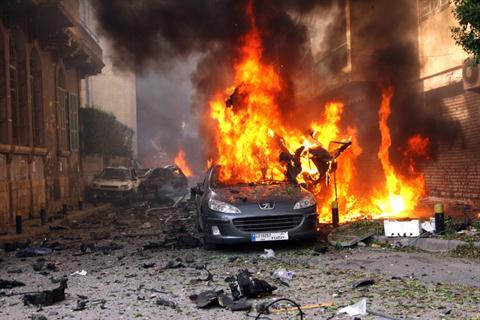
BEIRUT, Lebanon – At least three people were killed and over eighty injured by a car bomb in East Beirut’s Ashrafiyeh district during Friday afternoon’s rush hour. Wissam al-Hassan, the Internal Security Forces’ (ISF) intelligence chief, was among the dead.

Flames engulf a car at the site of Friday’s bomb attack in Beirut. (Photo courtesy of CNN)

Hassan had long been known for his anti-Syrian sentiment.  He was one of several intelligence officers who proved invaluable to the uncovering of a recent bomb plot that led to the arrest of Michel Samah, a Lebanese politician close to Syrian President Bashar al-Assad. Samah was accused of trying to help smuggle explosives into Lebanon.  Hassan was also involved in pursuing those responsible for a series attacks and assassinations in Lebanon between 2005 and 2008, including the murder of Rafik al-Hariri.

Saad Hariri, a former Lebanese prime minister, was who he thought was responsible for Friday’s bombing. His reply: “Bashar Hafez al-Assad. Who killed Wissam al-Hassan is as clear as day. Certainly the Lebanese people will not be silent over this heinous crime and I, Sadd Hariri, promise that I will not be silent.”

Others were not so quick to give their opinions on who was responsible. Ziad Baroud, another former Lebanese interior minister, said that it was too soon to tell who was behind the car bombing.

“High-ranking officials have not said anything so far, and therefore neither can I,” Baroud told Al Jazeera. “We have no indication whatsoever [of who is behind this]. We know this is a strong and sad message, and we know this could destabilize the whole country.”

The incident gives credence to fears that the civil war in Syria is spilling over into the country, which shares a border. Tensions between Lebanese factions caught on opposite sides of the conflict are heightening. Just two days ago, Lakhdar Brahimi, the UN-Arab envoy peace to Syria, warned that “you cannot expect the Syrian crisis to remain within Syrian borders.”

The explosion occurred in a predominantly Christian area on a street lined with shops, churches, and office buildings. There is usually a significant number of police in the area. According to Aram Nerguizian, a teacher at a school around the block from the attack site, the area is “among the safest” in Beirut.

For further information, please see:

Al Jazeera – Lebanon Intelligence Official Assassinated – 19 October 2012

CNN – Anti-Syrian Official Killed When Car Bomb Rocks Beirut – 19 October 2012

The Daily Star – Top Security Official Killed in Beirut Bombing – 19 October 2012

The Daily Star – Hariri Accuses Assad of Assassinating Lebanese Security Official – 19 October 2012

Washington Post – A Car Bomb in Beirut: Photos of Lebanon in Shock – 19 October 2012

France to Aid Mali Against Militant Group

By Heba Girgis
Impunity Watch Reporter, Africa

BAMAKO, Mali—France has began a mission with African nations to flush out Islamist militant groups linked to al-Qaeda in the northern region of Mali. Recently there has been mounting alarm over threats from these insurgents to both regional and western national security.

Mali’s Army Will be Retrained and Equipped to Fight Against Islamist Insurgents. (Photo Courtesy of The Telegraph)

These insurgents have ruled a large area of northern Mali since March of this year. This has divided the country in two. Francois Hollande, the President of France, gave a speech in Senegal and discussed “a reign of terror” in Mali, with “hands cut off, women raped and an area awash with weapons.” During Hollande’s trip to Africa, he began to rally regional leaders on the cause to work with Mali to change the state of affairs in the country.

The French plan is to create a force made up of troops from Mali and other countries in the Economic Community of West African States. While several countries are willing to cooperate, many of them do not have the capacity to mount an offensive operation without logistical and intelligence support. The French are willing to contribute but have decided not to send out ground troops and America is reluctant to get involved.

Late last week, the United Nations Security Council passed a resolution giving the West African states 45 days to create a plan to take back Mali’s northern region. This resolution has taken on a sense of urgency after these insurgents were linked to last month’s attack on the United States consulate sites in Libya that killed the United States ambassador there and three other American citizens.

West African nations have tentatively offered to send 3,300 personnel to aid Mali in its fight. The bulk of the personnel would come from Nigeria. Non-combat personnel will also be sent into Mali including police officers, engineers and doctors. Guinea-Bissau has offered to send its own personnel as well even though its army is currently occupied governing the country.

The Ivory Coast is another big backer of military support, along with Nigeria even though the Ivory Coast is hosting United Nations peacekeeping missions after its own civil conflicts.

To further complicate the situation, these insurgents are holding six French hostages—two were kidnapped in Mali last year. Dominique de Villepin, the former prime minister, warned that France should be cautious in this mission, saying that he feared that the country could get caught in a “trap.”


For further information, please see:

The Economist – An African Journey – 19 October 2012

FT World – Africa Force to Take on Mali Militants – 18 October 2012

The Telegraph – African Force Set for Northern Mali – 18 October 2012

The Wall Street Journal – Plan to Combat Mali’s Militants – 17 October 2012

Widespread Criticism Ahead of Refugee Center Opening

By Mark O’Brien
Impunity Watch Reporter, Oceania

CANBERRA, Australia — With the first boatload of refugees expected to arrive as early as the end of next week, local resentment toward the Australian processing center on Papua New Guinea’s Manus Island is growing.


Residents of Papua New Guinea’s Manus Island have criticized the Australian government for excluding them from key decisions as it prepares to reopen its refugee processing center on the island. (Photo Courtesy of Special Broadcasting Service Online)

On Wednesday, the governor of Manus Island criticized the Australian government for not consulting with locals about re-opening the asylum-seeker processing center, which was abandoned in 2004.

“[W]e are still in the dark about Australia assisting us,” Governor Charlie Benjamin said in an interview with the Australian Associated Press regarding a government aid package.  “That is arrogance.”

Benjamin said the same situation happened in 2001, when contracts were signed without any input from Manus Island officials.  This time around appeared to be different, however.  Two Manus representatives went to Brisbane last week for negotiation with Australian leaders, according to Benjamin.  But when they arrived, the Manus representatives were told the contracts for Australia’s aid plan were already handed out.

“We have no problem with Australian companies being considered because you want a job you would be satisfied with,” Benjamin told the AAP, “but we have tried our best to be involved in this, but they have not even consulted us.”

Local property owners are so fed up, they are prepared to take matters into their own hands.

On Thursday, landowners said they would sabotage the Australian processing center if their concerns were not heard, according to Radio Australia’s Pacific Beat.

“They’re prepared to start considering things like cutting the services that flow through their land to the processing center, things like road access, electricity access,” reported correspondent Liam Fox.

Residents complained of having very little information from the national and provincial governments, much the same frustrations expressed by Benjamin regarding the Australian government.  But Fox reported that the lack of information only compounds the speed with which the center nears opening.

“In just over a month, the Australian Defence Force engineers have transformed the place,” Fox said.  “It was overgrown with weeds and bushes and very dilapidated, and now it’s ready to take around 150 asylum-seekers.”

Even the head of Australia’s Human Rights Commission has expressed concerns.

Gillian Triggs said on ABC Radio Australia this week that she would like to inspect Australia’s offshore processing centers, including the one Manus Island.  She would like to see how things would work at the centers.

“I’m hoping that the government will work hard to ensure that there is a proper and speedy process,” Triggs said, referring to the reported risk of asylum-seekers being held in these types of centers for half a decade or more.  “[T]hat is our most particular concern, along with the mental illness that seems to go very directly with the concept of unlimited detention in confined contexts.”

But the Australian government indicated on Wednesday that not everything is as set in stone as it appears to be.

“The Australian government is yet to be advised of the preferred location of the site for the permanent facility on Manus,” read a statement issued by the Australian High Commission.  It implied that there is plenty of work and collaboration yet to finish and that it all is subject to change.

“Once the site is agreed, an experienced contractor will be appointed to build the facility consistent with the consultative terms of the Memorandum of Understanding signed by both governments on the establishment of the Regional Processing Centre.”

For further information, please see:

Australia News Network — Manus Landowners Prepared to Sabotage Asylum Seeker Centre — 18 October 2012

ABC Radio Australia — Australian Human Rights Commission President Plans Nauru, Manus Inspections — 17 October 2012

The Australian — Manus Refugee Facility Opening Is Clouded — 17 October 2012

Sky News Australia — Manus Governor Says Australia Arrogant — 17 October 2012

Special Broadcasting Service Online — Manus Refugee Facility Opening is Clouded — 17 October 2012