Buenos Aires First Legal Abortion

By Brendan Oliver Bergh
Impunity Watch Reporter, South America

BUENOS AIRES, Argentina – The Argentinian Supreme Court issued a ruling late Thursday night which granted an abortion to a women rescued from a prostitution ring.

nothing
Pro-Abortion Activists Rally In Buenos Aires. (Photo Courtesy of Today Online)

Argentina like most South America heavily identifies itself as Roman Catholic and 95% of all abortions that take place in the continent are illegal. Yet in March 2012 the Supreme Court ruled that abortions in the case of rape or pregnancies that threaten the women’s life are legal. Buenos Aires has since drafted regulations in order to implement that ruling, limiting the abortions to within the first 12 weeks of gestation of a rape victim’s pregnancy.

The 32 year old women, whose name has been withheld for security reasons had been kidnapped and forced in sexual slavery. Upon her rescue the women made the decision to go against her faith and the protests of her family and terminate her pregnancy.

However this would not be a private affair as controversy stirred up when anti-abortion activists identified the woman and protested outside her home, and then again at the hospital.

What was supposed to be Buenos Aires first legal abortion under the new abortion regulations turned into a spectacle of legal arguments and demonstrations from both sides of the debate. Scheduled for Tuesday, moments before surgery was supposed to take place the anti-abortion group “Pro-Family” received an injunction from a judge effectively stopping the procedure. The judge claimed that there had been no evidence of rape.

For another three days, the woman was forced to wait in what Amnesty International calls “cruel, inhuman and degrading treatment.” Debates on both sides of the argument stirred as the judge’s decision was appealed to the Supreme Court. Soon after the Supreme Court overturned the lower judge’s decision the trafficked woman was in the hospital despite numerous nurses and doctor’s refusal to take part.

Argentina’s Health Ministry made sure to clarify that abortion was indeed legal in certain circumstances and there would be no punishment for those who carried out the procedure.

Proponents for abortion call this a victory for women’s rights. In 2007 The National Health Research Program and the Ministry of Health of the Nation produced research that showed there were approximately 450,000 to 600,000 illegally performed abortions in Argentina.

The battle in Latin America continues, currently only Cuba has authorized full and legal abortions for its citizens. However, next week Uruguay will continue its legislative action and is expected to legalize elective abortion.

For further information, please see:

Today Online – Rape Victims Struggle To Get Legal Abortions In Argentina – 14 October 2012

La Nacion – They Have 5 Hospitals For Abortion – 13 October 2012

The BBC – Argentinian ‘Sex Slave’ Allowed Abortion After Ruling – 12 October 2012

CNN – Argentine Court Allows Abortions In Rape Cases – 14 March 2012

Pagina 12 – The Figures For Open Debate – 2 June 2007

Chávez Consolidates Power Post-Victory

By Margaret Janelle R. Hutchinson
Impunity Watch Reporter, South America

 CARACAS, Venezuela – Hugo Chávez, 58, won his third six-year term as president of Venezuela last week.  Yesterday he swore in a new vice president and replaced six senior Cabinet ministers.  Many of the replaced government officials announced their plans to run in gubernatorial races in states currently controlled by the opposition.

Chávez, surrounded by supporters, celebrates his victory last Sunday over opposition party candidate Capriles. (Photo courtesy venezuelanalysis.com)

It appears Chávez is wasting no time strengthening his party’s influence throughout the nation as part of his strategy to achieve his stated intention of remaining in power until 2031.

The race up to the election last Sunday October 7, 2012, was the tightest Chávez has faced since he first gained power in 1996.  The obvious inequity in campaigning has lead some to declare that the election was “free, but not fair.”  Nevertheless, Chávez won 55 percent of the vote in the election, beating the opposition candidate, Henrique Capriles Radnski, by 11 percentage points.

Chávez’s win may prompt a reexamination of relations between the government and the opposition, which, up until now, have been so polarized that neither side has recognized the other’s legitimacy. During the campaign, Capriles even refused to pledge himself to accept the official results announced by the National Electoral Council.

Signs immediately following the elections indicate that the mutual distrust may be easing.  Keeping a promise he made on election day, Chávez phoned Capriles and for the first time refrained from using derogatory language against his former rival.  More important, Chávez committed himself to “extending a hand” to his opponents and made a call for “national reconciliation,” which would even include business interests of all sizes.

All major opposition leaders firmly resist the use of massive government expenditures to finance ambitious goals.  Up until now, the programs that Chávez claims create the conditions for “socialism” have been financed by windfall oil revenue.  Thus, for instance, expropriations to bolster the nation’s mixed economy are designed to allow state companies to compete with private ones in hopes of controlling inflation, which at over 20 percent is the highest in the continent.  Another costly and ambitious area of investment has been community councils, which receive financing to carry out their own public works projects and to form what the government calls “communes.”  The main opposition parties may be divided with regard to the role of the state, but none of them go along with the type of transformation to which Chávez is committed.

Perhaps the knowledge that he couldn’t move forward with many of his plans with opposition leaders in power is what prompted Chávez to shake up his Cabinet yesterday.

Former Foreign Minister Nicolas Maduro, 49, replaced Elias Jaua as Chávez’s vice president. Maduro, a burly former bus driver, is considered the member of Chávez’s government with the closest ties to Cuba’s Fidel and Raul Castro.

The vice presidential job has assumed new importance because of Chávez’s recent struggle with cancer and rumors have circulated that Maduro is being groomed as his successor.

Jaua will be the ruling United Socialist Party’s candidate for the governorship of Miranda, Venezuela’s second largest state, which is the power base of Capriles.

Among the Cabinet changes was the appointment of General Nestor Reverol as the new minister of the interior and justice, replacing Tareck El Aissami, who will run to be governor of Aragua. Reverol had led Venezuela’s anti-drug body.

Admiral Carmen Melendez is the new head of the Office of the Presidency, replacing Erika Farias, who will seek the governorship of the west-central state of Cojedes.

Chavez also named journalist Ernesto Villegas to run the ministry of communications and public affairs; Aloha Nunez to the head of the ministry of indigenous affairs and Cristobal Francisco to the top post at the environment ministry.

In the swearing-in ceremony aired on state television, Chávez called on his new ministers to continue “the fight to transform the old capitalist and bourgeoisie state … into a socialist state.”

He also called for greater government efficiency.

Years of inadequate maintenance, corruption and perceived incompetence have left Venezuela’s infrastructure in a sorry state.  A blast in the Amuay oil refinery in late August killed 42 people (six are still missing).  Across the country, roads and bridges have collapsed or been washed away by rains, severing main transport arteries.

Citizens complain of crime, unemployment and poor public services.

Over the past year or so, the president has begun to spend his war chest. Calculations are that public spending has expanded by 30% in real terms over the 12 months prior to August.  Some of this has gone on new “grand missions”, as Mr. Chávez calls his social programs, the most important of which promised in 2010 to provide over 350,000 new homes by the end of 2012. That compares with under 600,000 new homes (by official estimates) in the previous 11 years.

Notably, over 3 million people are registered for the new program, providing the government with valuable electoral data.  The government insisted up to the election that an opposition victory would dash the hopes of the homeless, even though Mr. Capriles promised to keep that program going.

Chávez is at a strategy crossroads.  The continuation of far-reaching programs that invigorate the rank and file will meet resistance from opposition leaders who claim they are not sustainable over the long run.  On the other hand, major concessions to the opposition would run the risk of dampening the enthusiasm of his followers.  While the strategies of change and national reconciliation may not be mutually exclusive, it will take considerable political skill to combine the two in ways that overcome the intense political schisms that have divided Venezuela in recent years.

For further information, please see:

The Auburn Plainsman – Venezuela election reminder of how bad it could be – 14 October 2012

iFocus – Venezuela’s Chavez names new cabinet ministers – 14 October 2012

Fox News – Venezuela’s Chavez swears in vice president, 6 other ministers in post-election shake up – 13 October 2012

Reuters – Venezuela’s Chavez shuffles cabinet, then tweets about it – 13 October 2012

venezuelanalysis – Venezuela Reelects Hugo Chavez. What’s Next? – 12 October 2012

The Economist – The autocrat and the ballot box – 29 September 2012


Recent Recording of Al-Zawahiri Promotes Additional Violence and Protests

By Emily Schneider
Impunity Watch Reporter, Middle East

Middle East – Ayman al-Zawahiri, al Qaeda’s top leader, allegedly called for more protests against offensive depictions of the prophet Mohammed and praised the attack on the U.S. Consulate in Libya last month, according to a recently released audio recording.

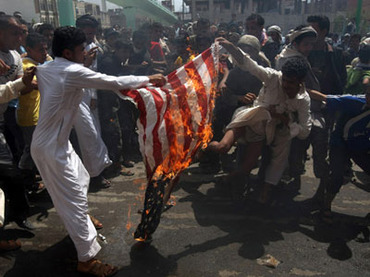
Yemeni protestors burn the American flag outside the U.S. embassy in Sana’a. (Photo courtesy of AFP)

Individuals around the Muslim world protested against “Innocence of Muslims,” an anti-Islam movie produced in the United States in the weeks after September 11. The video, which had been available online since July, went viral following the anniversary of the September 11 tragedy and sparked violent reactions throughout the Middle East.

Although many protests were peaceful demonstrations against the offensive depiction of the prophet Mohammed, quite a few protestors blamed the United States government for the film. The low-budget film was privately produced. U.S. officials have condemned the video, stating that it in no way reflects the views or opinions of the government and it was not sanctioned by Washington.

In Egypt, 224 people were injured in protests, according to the Health Ministry. In Yemen, demonstrators were able to breach embassy security and storm the grounds, where they burnt the American flag before being repelled by security forces. In Pakistan, mobs ransacked banks, cinemas, and government offices. Demonstrations also took place in Lebanon, Malaysia, and Bangladesh.

But the most troubling attack occurred in Benghazi, Libya, where four members of the U.S. Embassy were killed, including Christopher Stevens, the U.S. Ambassador to Libya. U.S. officials initially believed the attack on the U.S. mission compound was part of the demonstrations taking place immediately outside the compound. The protest was sparked by the “Innocence of Muslims” video and modeled after similar protests that took place in Cairo earlier that day.

But as more information has become available, U.S. officials have reevaluated their original assumption. It seems now, that the incident was not a spontaneous overflow of the protests, but instead an organized and deliberate, albeit opportunistic, attack. Officials now believe that “extremists” used the protests in Benghazi as a diversion to launch their attack on the compound.

“In the immediate aftermath, there was information that led us to assess that the attack began spontaneously following protests earlier that day at our embassy in Cairo,” Shawn Turner, spokesman for Director of National Intelligence James Clapper, said. “As we learned more about the attack, we revised our initial assessment to reflect new information indicating that it was a deliberate and organized terrorist attack carried out by extremists.”

Now, over a month since the first protests, demonstrations outside U.S. embassies are declining. Al-Zawahiri’s address to “free and distinguished zealots for Islam,” lauding those who have taken part in the demonstrations thus far, was posted on Islamic websites early Saturday and calls for a renewal of the protests.

Although the authenticity of the recording cannot be completely confirmed, al-Zawahiri offered a similar message in his last video in September, when he condoned violence in Syria. That video, entitled “The Lion of Knowledge and Jihad: martyrdom of al-Sheikh Abu Yahya al-Libi,” was released on September 11, 2012 and marked his thirteenth statement of the year. In that video, he confirmed the death of Abu Yahya, who was killed by a U.S. drone in Pakistan.

In the latest recording, al-Zawahari stopped just short of claiming responsibility for the attack on the U.S. compound in Benghazi. He did, however, offer support and praise to those who orchestrated the attack.

“May God salute the free honest believers who stood up and stormed the American Consulate in Benghazi and those who demonstrated in front of the American Embassy in Cairo and brought down the American flag and raised the banner of Islam and Jihad instead,” Ayman al-Zawahiri said in the recording.

“In the pretext of personal freedom and freedom of expression, America allowed the production of a movie that was aimed to defame the beloved prophet Mohammed, even though this alleged personal freedom that they boast about didn’t stop the Americans from torturing the Muslim prisoners” at U.S. facilities, the audio recording says.

“I call upon [protestors] to continue their confrontation against the American Zionist crusader transgression and I call upon all Muslims to follow their leads,” he said.

For further information, please see:

CNN- In Message, al Qaeda Leader Purportedly Calls for More Protests – 13 October 2012

The Guardian – Al-Qaida Leader Calls for Holy War on US and Israel over Anti-Islamic Film – 13 October 2012

RT.com – Al-Qaeda Leader Calls for More Anti-US Protests – 13 October 2012

CNN – What We Know About the Libya Attack – 14 October 2012

CNN – Death, Destruction in Pakistan Amid Protests Tied to Anti-Islam Film – 21 September 2012

Al Jazeera – Hate Video, Muslim Protests and Dignified Responses – 20 September 2012

BBC News – Anti-Islam Film Protests Spread Across Middle East – 13 September 2012

Nephew of Chinese Activist Chen Guangcheng Faces Criminal Charges

By Irving Feng
Impunity Watch Reporter, Asia

BEIJING, China – Nephew of blind Chinese activist, Chen Guangcheng, faces charges of intentional infliction of injury after being detained for five months without any communication with friends, family or legal counsel.

Chen Guangcheng (Left) and his brother (Right), father of Chen Kegui. (Photo courtesy of The Daily Beast)

Chen Kegui was taken into custody shortly after his uncle, Chen Guangcheng, escaped an alleged illegal house arrest and fled to the United States back in April.  Chen Guangcheng, was under house arrest at his farm house, evaded dozens of armed guards, hidden cameras and other security measures during his miraculous escape.  He made his way to the American Embassy in Beijing and eventually to the United States.

Chen Guangcheng had been in prison for four years prior to his 19 month house arrest stint for openly protesting China’s family planning policies involving forced sterilizations and forced late term abortions.  Chen was imprisoned for inciting social unrest, disrupting traffic and causing property damage.  His escape was seen as a great embarrassment to the Chinese government.

Shortly after his escape, plain clothes police officers entered the home of Chen’s nephew, Chen Kegui, and beat him and his family.  The policemen scaled the wall and beat Chen Kegui in the courtyard of his Shangdong home.  When Chen Kegui grabbed a knife from the kitchen in order to defend himself and his family, three of the attackers were allegedly injured by his defensive actions.

The family alleges that it was impossible to tell that the attackers were in fact local police.  They did not wear any uniforms, did not announce their identity, and intruded the home without any proper documentation such as a search warrant.  Chen Kegui was hauled away by the police and initially charged with intentional homicide.

Chen Kegui was allegedly beaten and interrogated for several days after the abduction regarding the whereabouts and escape of his uncle.  The family has not seen their son since the incident at their Shangdong home.  They have only received a formal notification of the arrest from the police and the possible charges against Chen Kegui.

Although the charges have since been dropped down from intentional homicide to intentional infliction of injury against the policemen who abducted Chen Kegui, Jerome Cohen, an expert on Chinese law at the New York University School of Law, believes there is a high likelihood of conviction.

Given the high profile nature of the case and the possible connection to Chen Guangcheng’s escape and embarrassment suffered by the Chinese government, the outcome of the case may have already been decided by local party officials.  The formal proceedings such as the indictment and trial may be just a charade to fabricate some semblance of a fair and just legal system.

For further information, please see:

The Daily Beast – Chinese Dissident Chen Guangcheng’s Nephew Faces Assault Charges – 13 October 2012

The New York Times – Charges Likely for Chinese Activist’s Nephew – 13 October 2012

Radio Free Asia – Chen’s Nephew Faces New Charges – 13 October 2012

Reuters – Blind Chinese activist says nephew could face unfair trial – 13 October 2012

Islamic Militant Group Al-Shabaab Tweets Ban on Islamic Relief Aid

By Ryan Aliman
Impunity Watch Reporter, Africa

MOGADISHU, Somalia – Somali rebel group Al-Shabaab has banned foreign aid agency Islamic Relief from providing aid to territories under its control.

Harakat Al-Shabaab Al Mujahideen Press Office (HSM Press), Al-Shabaab’s official Twitter account. (Photo courtesy of The Daily Mail)

In a statement posted on Al-Shabaab’s official Twitter account, the Somali-based cell of Al-Qaeda gave the following reason for the ban: “Islamic Relief has repeatedly failed, despite the persistent warnings, to comply with the operational guidelines.” It accused Islamic Relief of “covertly extending the operations of banned organisations, particularly WFP.”

The World Food Programme (WFP) and other United Nations organizations were denied access to Al-Shabaab controlled areas two years ago by the rebel group. Al-Shabaab also forced out the International Committee of the Red Cross, along with 16 other aid agencies from Southern Somalia, earlier this year. According to Al-Shabaab authorities, these “western charities” allegedly exaggerated the scale of drought in Somalia and passed such inaccurate information to foreign agencies.

Al-Shabaab’s tweet came as a surprise to  Islamic Relief who has been providing aid to Somalia since 1996. Islamic Relief found it unusual for Al-Shabaab to issue such a ban without notifying the aid agency beforehand. The UK-based aid agency says it has yet to be officially informed of the decision. “Normally, al-Shabaab will talk to you first, then they will show their dissatisfaction,” said Iftikhar Ahmad Shaheen, regional director for east Africa at Islamic Relief. “We didn’t hear anything from them whatsoever for the past month… The staff [in Somalia] didn’t know anything.”

Shaheen also denied being funded by and conniving with the WFP. “I can testify that to the best of my knowledge, for the past five to six years, Islamic Relief has never worked with WFP in Somalia,” Shaheen told the press last week.

Islamic Relief is currently working on an appeal to Al-Shabaab to withdraw the ban. Shaheen noted that if the prohibition will not be lifted, “it could put many lives at risk, jeopardising our work providing food, water, sanitation, healthcare and support for income generation to 1.3 million people in Somalia.”

Two weeks ago, another aid agency, Oxfam, issued warnings that “water and food shortages are at critical levels” across the country with conditions “likely to deteriorate in parts of the country over the coming months.” It reported that southern Somalia – especially parts of the Gedo region, Lower Juba and Bakool – remains in crisis.

A severe drought hit Somalia last year that affected nearly 12 million people and caused several areas in the country to be declared as famine zones. The 2011 drought is recorded as one of the worst droughts to affect east Africa.


For further information, please see:

AFP – Somali rebels ban aid group Islamic Relief – 09 October 2012

Al Jazeera – Al-Shabab bans Islamic Relief aid group – 08 October 2012

BBC News – Somalia’s al-Shabab militants ban Islamic Relief aid – 08 October 2012

The Guardian – Somalia facing aid shortfall after al-Shabaab bans Islamic Relief – 08 October 2012

The Daily Mail – Terrorists on Twitter: Islamic extremists al-Shabaab launch micro-blogging account (… and guest what, they follow no-one!) – 9 December 2011