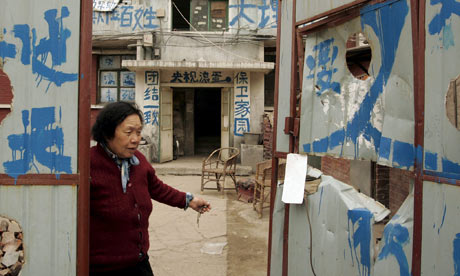
BEIJING, China – On Thursday, Amnesty International released a report entitled Standing Their Ground whichstated that large stimulus expenditures after the global financial crisis are responsible for a spike in evictions over the past three years in China.
Graffiti reads that the tenants are victims of eviction. (Photo Courtesy of The Guardian)
According to Aljazeera, hasty construction surges primarily caused the increase in people being forcibly removed from their homes. This was especially evident in years 2008 and 2010, during which China hosted the Olympics in Beijing and World Expo in Shanghai.
Though citizens are able to purchase and sell land rights which last for 70 years, the Chinese government legally owns all land. As a result of recent property disputes, violence and instability reign.
Amnesty International’s 85-page report, assembled between February 2010 and January 2012, asserts that violence against residents has resulted in imprisonment, self-immolations, and death.
“The problem of forced evictions represents the single most significant source of popular discontent in China and a serious threat to social and political stability,” read the report.
According to Amnesty, nine of forty forced evictions resulted in the deaths of people resisting eviction. A 70-year-old woman was allegedly buried alive by an excavator as she attempted to prevent workers from demolishing her home. In another incident, authorities purportedly took a baby from its mother and refused to return it until she signed an eviction order.
“Potentially, millions of people in the country are at risk of these illegal forced evictions and indeed protests about forced evictions are the single biggest issue of populist discontent in the country,” said Amnesty’s senior director of research, Nicola Duckworth. “So it’s a huge issue; it’s been going on for many, many years. We feel it’s rising in scale now and it’s really time to put an end to it,” continued Ms. Duckworth.
In response, the government stated that Amnesty’s report lacks credibility.
Last year, the government implemented regulations forbidding the use of violence in urban evictions. It further granted urban owners confronting eviction new protections such as the right to air complaints in public hearings, file appeals, and collect suitable compensation.
Nevertheless, these recent regulations neither apply to people in rural areas or renters.
By Justin Dorman Impunity Watch Reporter, Middle East
CAIRO, Egypt – In Egypt, every step President Mohammed Morsi takes towards rectifying a past injustice is accompanied by another step, of his own, in the opposite direction. Morsi recently issued a general amnesty decree that pardoned all political protesters who have been imprisoned since January 2011.
President Mohamed Morsi recently pardoned thousands of previously detained protesters. (Photo Courtesy of Amnesty International)
The pardon mainly affects those who were detained for “supporting the revolution” between January 25, 2011 and June 30, 3012, when Morsi began his presidency. Such individuals were mainly civilians who were tried in military courts on charges of possession of weapons, violating curfew, damaging property, and even “thuggery.” Although this decree frees many detainees, it does not extend to everyone.
It does not cover any individual who has been convicted of murder. While such an exception seems reasonable on its face, it still holds serious implications on the right of an Egyptian to have a fair trial. Approximately 1,100 civilians will remain in jail after being found guilty of charges like murder, rape, theft, embezzlement, and use of force with weapons in military courts.
“Military courts cannot be used to try any civilians and those imprisoned after military trials must be referred for re-trial before the ordinary judiciary or released,” said Amnesty International’s Deputy Director of the Middle East and North Africa Programme, Hassiba Hadj. “Equality before the law means that all Egyptians have the right to a fair trial regardless of the nature of the accusations.”
Amnesty International urged Morsi to take further steps in fighting impunity. Though Morsi created a committee to investigate the killings of protesters under Hosni Mubarak and the Supreme Council of Armed Forces (SCAF), little of any substance has resulted from this review. Only three soldiers were convicted of manslaughter when dozens of Coptic Christians were killed in last year’s Maspero protests, and only one member of the riot police is being tried for death and injury to protesters.
What President Morsi is actively trying to do is replace Attorney General Abdel-Meguid Mahmoud, regardless of the removal violating Egyptian law. The Attorney General is supposed to be insulated from political pressures, so his removal is prohibited unless he consents to it. Despite this, Morsi has appointed Mahmoud as the country’s ambassador to the Vatican and named Abdul Aziz the new Attorney General. This action came days after Mahmoud, a Mubarak appointee, failed at obtaining judgment against twenty-four members of the Mubarak regime for their connection with the “Battle of Camel.”
Yesterday, Morsi supporters congregated in Cairo’s Tahrir Square to protest these acquittals. Similarly, anti-Morsi protesters went to Tahrir Square to demonstrate against the Muslim Brotherhood’s monopolization of Egypt’s new constitution. The anti-Morsi activists were the first to the square but were kicked out because of their chants. Eventually, they came back in greater numbers, but were then surrounded when more Morsi supporters showed up. After the two factions chanted at each other for hours, violence inevitably broke out.
“They trapped us from both sides after attacking our stage where we were chanting,” claimed Ibrahim El-Sheikhh, an anti-Morsi protester. “As they beat me, they chanted Allahu Akbar [God is Great] and said they’d kidnap me, but I managed to escape. This is the Muslim Brotherhood.”
Additionally, it was reported that stones and Molotov cocktails were thrown as the opposing protesters clashed in Tahrir Square.
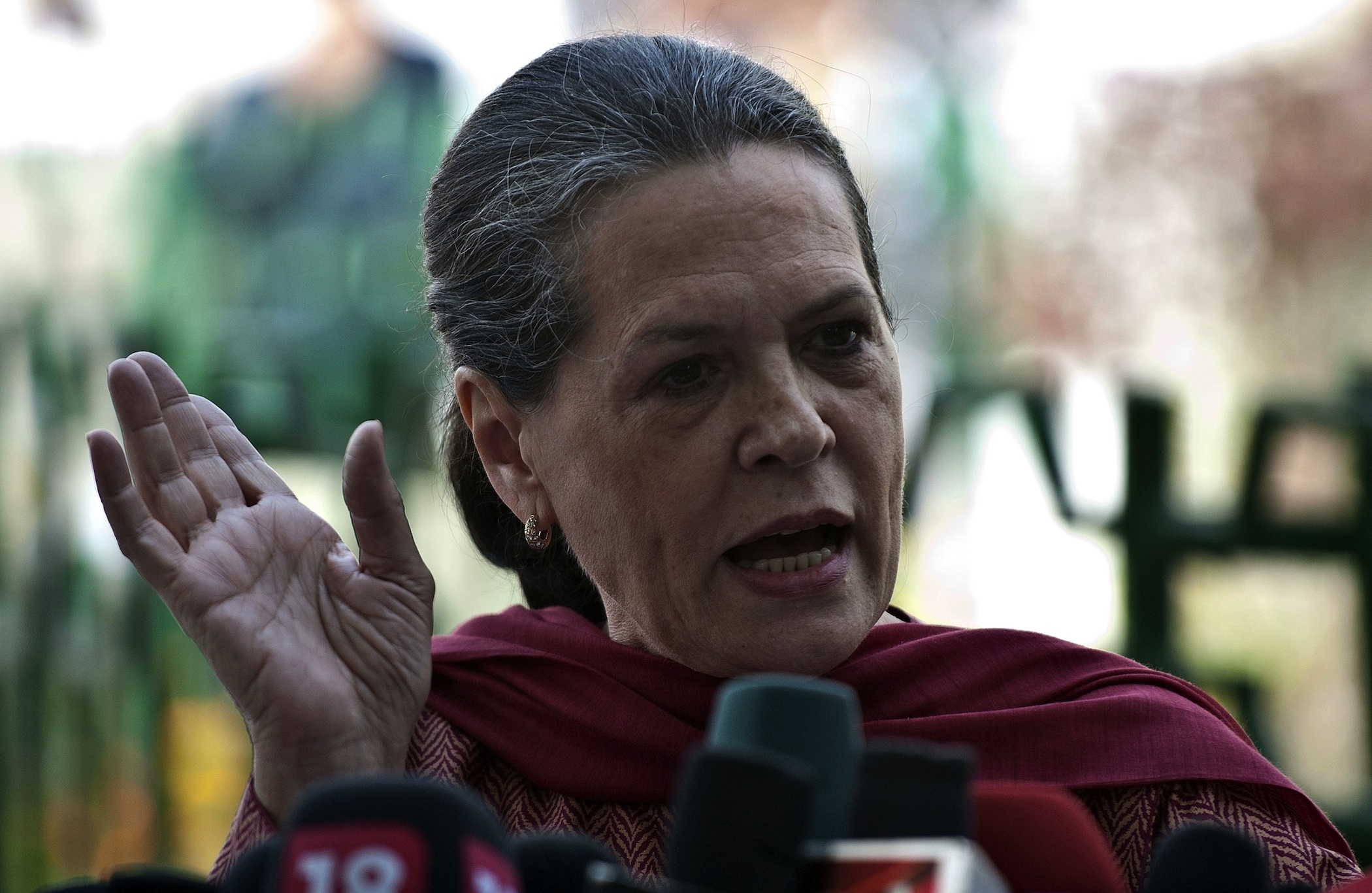
NEW DELHI, India – On Tuesday, Sonia Gandhi, president of India’s ruling Congress party, denounced the increase in rape victims. Ms. Gandhi visited the home of a 16 year-old victim who had recently committed suicide.
Gandhi speaks to the media. (Photo Courtesy of NY Daily News)
“We will take strict action against the offenders,” promised Ms. Gandhi during her visit. “Such barbaric acts are condemnable . . . [and] rapists should be given the severest punishment.”
According to New York Daily News, Ms. Gandhi, who is considered the most powerful politician in India, travelled to the girl’s village in the Haryana state to meet the victim’s relatives and relay the government’s outrage over the surge in such crimes.
“Now I am hopeful justice will be done,” said the victim’s mother after meeting Ms. Gandhi.
Last week, the victim burned herself to death after being gang-raped by men in the Jind district just 80 miles from New Delhi. Furthermore, according to media reports, authorities have arrested five men, one of which was a police officer.
Over the last seven years, rape cases in the Haryana state have doubled. Moreover, this past September, there were 12 purported rapes, and according to BBC, most of these victims were underage Dalits (formerly known as “untouchables”).
A member of Ms. Gandhi’s party, Phool Chanda Mulana, stated, “[S]uch incidents have happened earlier.”
On September 18th, a man committed suicide by swallowing pesticides in the Hisar district after he learned that 12 men gang-raped his underage daughter. Furthermore, on October 1st, a man allegedly raped a 15 year-old Dalit girl with learning disabilities in the Rohtak district. Within the same area and just two days after, a 13-year-old girl was purportedly raped by her 45-year-old neighbor.
In response, Haryana’s police chief, Ranjiv Dalal, asked the media to “exercise restraint” while reporting these attacks. Mr. Dalal further stated that from January to August, the number of rape cases in the state had decreased to 455 rapes this year compared to 534 the same time last year.
“The nature of the crime created hype in the number of rape cases registered in Haryana,” said Hisar district’s Police Superintendent, Satish Balan. “In two cases there were suicides which led to media coverage of rapes in Haryana otherwise the number of rapes registered has come down by 15%. This is the truth.”
Four U.N. agencies urged the Indian government to give the issue urgent attention in a letter to the country’s minister for Women and Child Development.
By Alexandra Sandacz Impunity Watch Reporter, Europe
LONDON, United Kingdom – On Friday, the Norwegian Nobel Committee awarded the European Union with the 2012 Nobel Peace Prize for its dedication “to the advancement of peace and reconciliation” in Europe.
The European Union was awarded the Nobel Peace Prize on Friday. (Photo Courtesy of The New York Times)
More specifically, the Nobel committee chose the European Union because of its 60-year-long contribution “to the advancement of peace and reconciliation, democracy and human rights in Europe.” The committed focused on the EU’s reconstruction after World War II and its ability to spread stability to communist countries after the fall of the Berlin Wall.
Thorbjoern Jagland, the Nobel committee chairman, said, “The stabilizing part played by the European Union has helped to transform a once torn Europe from a continent of war to a continent of peace.”
However, some European citizens and groups reacted to the announcement with skepticism.
Martin Callanan, the leader of the Eurosceptic Conservatives and Reformist Party in the European Parliament, responded, “The Nobel committee is a little late for an April fool’s joke. Twenty years ago this prize would have been sycophantic but maybe more justified. Today it is downright out of touch.” He continues, “Presumably this prize is for the peace and harmony on the streets of Athens and Madrid.” Callanan references the recent violent backlash in Europe created by the EU-backed economic austerity programs.
Matthew Price, a BBC Europe correspondent, does not doubt that the EU’s achievements are well established, but he also commented that the committee “picked a strange time to highlight these achievements.” He believes that the eurozone crisis has made the EU look divided and fragile.
Conversely, German Chancellor, Angela Merkel, regards the Nobel Peace Prize as a “personal incentive” to build on six decades of peace in Europe. “We must never forget that in order to keep this peace, democracy and freedom, we have to work hard over and over again,” she said.
Similarly, French President, Francois Hollande, believes that the EU needs to prove its worthiness of the award. He says, “we are honored, we are proud and at the same time we have our responsibilities before us.”
The prize, worth $1.2 million, will be presented in Oslo, Norway on December 10, 2012.
By Madeline Schiesser Impunity Watch Reporter, Europe
MOSCOW, Russia – On Wednesday, a Moscow City appeals court upheld the convictions of punk band Pussy Riot members Maria Alekhina, 24, and Nadezhda Tolokonnikova, 22, and releasing their band mate Yekaterina Samutsevich, 30. Alekhina and Tolokonnikova’s convictions for hooliganism motivated by religious hatred and sentences of two years in prison were maintained by the court. Samutsevich’s sentence was suspended because she was prevented from actual participation in the acts ruled hooliganism.
Samutsevich (L), Alekhina, and Tolokonnikova (R), sit inside the defendant’s glass box, colloquially called the “aquarium,” before their hearing on Wednesday. (Photo Courtesy of the Moscow Times)
The three women were arrested and charged after a protest on February 21 in which five members of Pussy Riot entered Moscow’s Russian Orthodox cathedral, snuck into a restricted area in front of the iconostasis, and for about a minute performed their song, “Virgin Mary, Get Putin Out” before they were removed by security. Two members of the band have fled the country.
Samutsevich, as her lawyer argued before the appeals court, did not have time to remove her guitar from its case before she was escorted out of the cathedral by guards, and therefore did not participate in the performance.
On August 17, after a trial in which the defense was permitted to call no witnesses, the prosecution did not question the defendants, and the defendant’s words were often objected to by the judge, according to The Guardian, Moscow’s Khamovnichesky District Court handed down its decision of guilty. Samutsevich, Alekhina, and Tolokonnikova were sentenced to 2 years in prison.
Outside of Russia, the imprisoned women have received much support, including being on the short list for the Sakharov Prize. According to the BBC however, within Russia 43% of those polled found the sentence to be too lenient.
On Sunday, Russian President Vladimir Putin asserted “It was right that they were arrested, and the court’s decision was right.”
During appeal, Samutsevich replaced her lawyer with Irina Khrunova, who once represented jailed former Russian oil businessman Mikhail Khodorkovsky. Khrunova argued that Samutsevich had committed only an “unfinished crime” or “inchoate crime” and therefore should receive a lighter sentence.
Alekhina and Tolokonnikova also pled for leniency on the grounds that each is the mother of a small child.
Although they maintain that their protest was political in nature, and were not motivated by religious hatred, the women have apologized if they offended anyone. “If we unintentionally offended any believers with our actions, we express our apologies,” Samutsevich said in court Wednesday.
This echoes Alyokhina’s assertion in August, “Dear believers, we didn’t want to offend you,” she said. “We went into the cathedral to issue a protest against the fusion of the spiritual and political elite of our country.”
Samutsevich’s release was met with excitement. She hugged her band mates, who smiled and tearfully said goodbye to her before she was led out the courtroom and quickly whisked away from the media.
Samutsevich will be on probation for two years, during which time she cannot change housing without notifying authorities, must report to authorities once a month, and cannot participate in any similar performances, or she will be sent to prison.
However, Samutsevich has vowed that she will not be silent: “Of course we are not finished, nor are we going to end our political protest.” She also claimed the verdict had been influenced by the president. “You can see the flaws of the judicial system in Russia. It depends very much on the opinion and the stance of the President.”
The appeals court took the unusual step of publically defending its decision. The court claimed that Alekhina and Tolokonnikova remained in prison because they are a threat to society, and Samutsevich was freed due to her “level of participation.”
Alekhina and Tolokonnikova’s lawyers will file supervisory appeals maintain a non-guilty plea in order to continue the appeal process. However, the women’s sentences are effective immediately. Their lawyers have also expressed plans to appeal to the European Court of Human Rights in Strasbourg.
Within ten days of receiving the judge’s written decision Alyokhina and Tolokonnikova will be moved to a yet undetermined prison to serve their sentences. Their lawyers moved to have the women serve their sentences where they have been since March so that their families could communicate with them; however authorities refused this request, according to RT. According to the Guardian, the two are likely to be separated.