AMSTERDAM, Netherlands – Gambian lawyer, Fatou Bensouda, was sworn in as the new chief prosecutor of the International Criminal Court (ICC) replacing Argentinian Luis Moreno-Ocampo.
Fatou Bensouda takes the oath. (Photo Courtesy of AFP)
Fatou Bensouda was born in Banjul, Gambia to a civil servant and a housewife. After graduating with a Bachelor of Law degree from the University of Ife in Nigeria, she went on to pursue her Barrister at Law at the Nigeria Law School in Lagos. She later acquired a Master of Laws from the International Maritime Law Institute in Malta making her Gambia’s first expert in international maritime law and the Law of the Seas.
In 1987, she returned to Gambia to begin her career as a public prosecutor. Ten years later, she was appointed as Gambia’s justice minister and attorney-general.
As a Legal Adviser and Trial Attorney at the International Criminal Tribunal for Rwanda (ICTR) prosecutor’s office, she handled cases on the 1994 Rwandan genocide wherein approximately 800,000 people were killed. She later rose to the position of Senior Legal Advisor and Head of The Legal Advisory Unit.
By virtue of the Assembly of States Parties to the Rome Statute (ASP), the ICC’s founding document, Fatou Bensouda was elected ICC prosecutor in December 2011 by the 121 state signatories. Judge Sang-Hyun Song, president of the ICC, vouched for her competence saying, “I am confident that her strong independent voice, legal expertise and genuine concern for human rights issues will contribute greatly to the continuous fight against impunity.”
Bensouda’s inauguration was also hailed by non-governmental groups. “Fatou Bensouda is extremely qualified to lead the office of the prosecutor,” said Willam Pace, the head of the Coalition for the International Criminal Court, a body which monitors the work of the tribunal.
Bensouda, who took the oath of office last week, specifically stated that she shall be carrying on with the seven situations, 14 cases (two of which are Kenya’s post election violence cases), and a further seven preliminary investigations that Ocampo had initiated.
However, Bensouda’s election was not devoid of criticisms. The African Union was concerned that the prosecutor might have a tendency to single out African cases. Bensouda countered that she will not target any particular state. Guided by the ASP, she promised to be even-handed in dealing with all the 121 state parties.
“I am humbled by the privileged responsibility that the state parties have bestowed on me. I am also thankful to the African Union for supporting my candidature which shows that they are committed to fighting impunity,” she said during the brief ceremony inside the chamber. “The Office of the Prosecutor,” she added, “will continue to work with other partners namely other offices of ICC, rights groups and the state parties.”
As the world plays games of hide-and-seek and wait-and-see in regard to our “situation,” “worrying” and “tragic” as it is, the only thing we have is our resistance, our refusal to break even when faced with so much hypocrisy and indifference and with odds that so many would consider insurmountable. For the first time since the introduction of the term of “popular resistance” into our lives, it has finally become a true way of life for us.
Thursday June 21, 2012
Death Toll: 66. The Breakdown: 24 in Hama, 20 in Damascus (17 in the Suburbs, mostly in Douma, and 3 in Damascus City), 7 in Daraa, 5 in Homs, 3 in Aleppo, 3 in Lattakia, 3 in Idlib, and 1 in Deir Ezzor.
The UN video footage, once they were able to enter the village of Al-Qubeir and document the incident.
Location: Al-Qubeir Farm is located 20 KM west of Hama city and 2 KM south of Marzaf Village. Description: Al-Qubeir Farm is a small community consisting of 25 houses, and its population is approximately 150 people Date of incident : 06/06/2012 The witnesses:
1. Ahmad X (survivor) | age:45
2. X (survivor) | age: in her forties
3. witness code #12001 | Marzaf villager
4. witness code #12002 | Marzaf villager
Reporting of the Incident, Based on Interviews With the Witnesses:
On Wednesday June 6th 2012 at about 12:30 pm an armed group, consisting of 6 personnels who were wearing plainclothes and who carried Kalashnikovs weapons, attacked a checkpoint that belonged to the Syrian army. This was done to save a person arrested earlier the same day and detained, at the previously mentioned checkpoint. During the combat, a reinforcement from the Syrian army was sent, it was composed of 3 tanks, T72 type, some military armoured vehicles, and some military trucks, Zell type (Russian made). These full- armed reinforcement besieged the attacking group and clashed with them; leading to the deaths of all 6 men: (1)Mohammad Hassan Elwan, Hama- Greggis village; (2)Mahdi Ahmad Elwan, Hama-Greggis village; (3)Sari Ali Al-Hamdou, Hama-Greggis village; (4)Emad Ismail Elwan, Hama-Greggis village; (5)Mohammad Saleh Elwan, Hama-Greggis village; (6)Salah Jameel Elwan.
Afterwards, the tanks headed towards Al-Qubeir village along with the Zell trucks, six white buses, oil-colored armoured vehicles with the words “Riot Control” on the side of one, and other pick-up trucks carrying forces outfitted in the Syrian Armed Forces uniform. These troops all had personal weapons,most of the weapons displayed were Kalashnikovs and BKC machine guns.
The witnesses said that there were other civilian vehicles –2 pick-up Hyundai white tucks, other pick-up trucks, and small trucks (the natives call them Torteera or Torzena), these vehicles had civilians who accompanied the military forces. The people in them wore plainclothes and carried small weapons such as: sticks, knives, and daggers. Some of them carried pistols and Kalashnikovs
Between 1:40 and 1:50 pm, the previously mentioned armed forces besieged the village from three axis (The Northern Axis: Mezrav village direction; the Eastern axis: Al-Majdal direction; and the western axis: Al-Taweem village direction).
Once all of the forces took up positions, 4 shells were launched directly on the houses, without any earlier warning. Next, the heavy and medium guns were used to fire at random on the houses. After roughly 10 minutes, the tanks stormed into the village along with the security forces, wearing the alternative uniform that belongs to the Syrian Armed Forces, and the civilians, who wore plainclothes. They began shooting heavily. The sound of gun fire lasted intermittently inside the village for about an hour and a half, however the forces remained in the village until 7:30 PM.
According to one female survivor’s report, Feda Al-Yateam, the forces would get the people out of their houses and would shoot them directly. She added that the forces, wearing the plainclothes and carrying sticks, took her husband along with other civilians from the village. The villagers take were made to lay down on the ground and then were beaten on their heads with sticks, until those administering the beating knew the villagers were dead. After that the attackers burned the bodies, another witness, with the code #12001, said that he saw the army retreat from the village. Witness #12001 then dared to enter the village, so that he could administer aid to any survivors. Upon entering the village, he reported seeing a woman who had been shot in the chest with her right hand cut off at the wrist. Next to her there was a baby’s body, he had been stabbed in his chest with a sharp tool and enough force that his internal viscera had fallen out onto the ground.
Witness #12001 also added that he saw in front of another house three children’s bodies. All of them were behind a woman’s body. The four bodies were in sitting positions, and the scene displayed implied that the woman was trying to protect the children when they were all shot at point blank range.
Another survivor, a male, Ahmad Al-Yateam, said that he was hit repeatedly with sticks and shotguns on his head and his body. Some of his attackers wore the Syrian military uniform, and others wore plainclothes. Al-Yateam said that he was brutally beaten until he became unconscious.
Another witness, code #12002, said that before the military forces withdrew from the village, there were 6 ambulances that arrived and took some of the bodies. The witness said that the number of bodies taken was between 25-30, then the ambulances also withdrew from the village, accompanied by the forces.
Witness #12001 recalled that a bold green armoured vehicle, belonging to the Syrian Armed Forces, attached two bodies with a rope to the truck and dragged them on the ground while heading west to a place known locally as Aseela Road.
While the survivors and the locals claimed that there were over 100 people killed in this massacre, we managed to document 54 victim’s names. In addition to the 6 individuals killed in the clash at the checkpoint. The reason only 54 victims were documented is due to a variety of reasons. First, the bodies of some of the victims were completely disfigured or deformed, to the point that the locals couldn’t recognize it to identify. Second, there exists an incapacity to find some of the victims as their bodies are missing, or taken by the attacking force. Additionally, the Syrian government and military refused to make a comment on the Al-Qubeir incident, after failing to conduct a real and honest investigation.
Furthermore; the government and the security forces refused to let the international observers, who were stationed in Hama city, enter the area and document the incident. Those who attempted to enter the next morning, on June 7th, were stopped, and told to return to Hama city, at one of the many checkpoints surrounding the area where the massacre took place. The observers were thus prevented from heading into the village to gather accurate information.
The information contained in this report was provided by:
By Mark McMurray Impunity Watch Reporter, Middle East
MANAMA, Bahrain — On Wednesday, a Bahraini court postponed the verdict of 11-year-old Ali Hasan until July 5. Hasan has been accused of participating in anti-government protests.
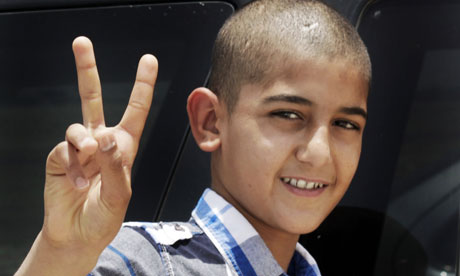
Ali Hasan after posting bail. (Photo Courtesy of the Guardian)
The prosecution accuses Hasan of assisting protesters by blocking a street with trash containers and wood last month during protests in Manama. Hasan’s defense claims he is a child who was merely playing with friends in the street at the time. Defense attorney Mohsen al-Alawi has called on the court to drop all charges.
Until he posted bail last week, Hasan was in prison, spending the last few weeks in custody awaiting his trial. As a result of this incarceration, Hasan, a sixth-grade student, had to take his school exams behind bars. During his time there, he roomed with three other children and was forced to clean the facility.
Hasan spoke with the Guardian newspaper by phone from his parents’ home in the Bilad al-Qadeem suburb of the capital. “I cried all the time but I became friends with the other boys there and we could play for four hours every day – but had to spend all our other time in a locked room,” he said about his time in jail.
The day before his arrest, there was fighting between protestors and police near Hasan’s house. Demonstrators used burning tires and trash cans to block the street. The next afternoon, Hasan was on the street playing with friends when the police came. “While we were playing there, some police forces came towards us which made us panic. My friends managed to run away … but I was so scared by the guns they were carrying that I couldn’t move … and I was arrested,” he said. Following his arrest, Hasan was taken to a variety of police stations where he was forced to confess to involvement in the protests. “I was crying all the time. I told them I’d confess to anything to go back home,” he added.
On Wednesday, the government defended its handling of the Hasan case. It concluded he was arrested for blocking a road, held in police custody for only six hours, and then transferred to juvenile detention for the next month. The government contends that Hasan was paid by a man to cause trouble on the street. Chief of Public Security Tariq Al Hassan said, “What is deplorable is how some older people will take advantage of vulnerable youth for their own political purposes.”
There have been some concerns surrounding Hasan’s case. Mariwan Hama-Saeed of Human Rights Watch said, “He was not accompanied by a lawyer during his questioning [and] it seems the only evidence used against him is his own confession and the testimony of a police officer.”
Hasan’s case is just one of the more recent examples of the government’s crackdown on protestors since unrest began in Bahrain fifteen months ago. The political unrest pits the Shiite majority, seeking a greater political voice, against the ruling Sunni dynasty. Since the upheaval began in February 2011, more than 50 people have died.