Shia Pilgrims Attacked in Iraq

By Mark McMurray
Impunity Watch Reporter, Middle East

BAGHDAD, Iraq — On Tuesday, a bomb killed at least two people who were part of a Shia pilgrimage in honor of a revered imam.  The attack in the capital follows an attack earlier in the week which killed pilgrims making the annual trip.
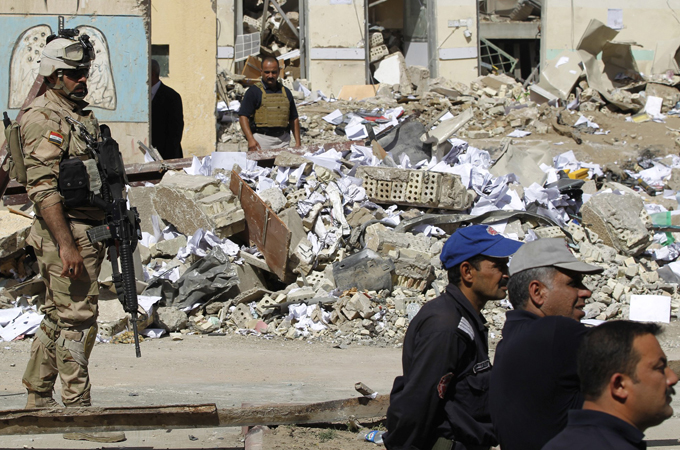
Iraqi security inspect the site of a bomb attack in Baghdad.  (Photo Courtesy of Al-Jazeera)
Iraqi security inspects the site of a bomb attack in Baghdad. (Photo Courtesy of Al-Jazeera)

The bomb attack hit pilgrims in the neighborhood of Saydiyah in Baghdad as they marched to a shrine built to commemorate the death of Imam Moussa ibn Jaafar al-Kadhim.  With the barrage of attacks leading up to the event’s climax on Saturday, there are fears of increasing tensions between Shia and Sunni Muslims.  The two groups have been in a deadlock, predominantly along sectarian lines, in Iraq’s coalition government.

Tuesday’s attack occurred after security was increased for devotees after a similar attack on Sunday killed seven pilgrims and wounded thirty-eight others.  On Sunday, two mortar rounds struck a square filled with Shia pilgrims in Baghdad’s northwestern Kadhimiya district, where they were gathering ahead of the religious festival.  In a bid to prevent further violence, security forces have been on high alert, tightening security around the al-Kadhim shrine.  The increased security for the event includes a vehicle ban and a search of anyone entering the area.

The annual pilgrimage marks the eighth century death of al-Kadhim, one of the twelve main Shia saints, who is said to be buried at the shrine.  In recent times, the al-Kadhim procession has been struck by tragedy.  In 2005, some one thousand pilgrims died following a stampede on a bridge caused by rumors of a suicide bomber.  Poor crowd control and the fear of attacks prevalent in Iraq were blamed as no explosives were found on the Bridge of the Imams, which leads to the golden-domed shrine.

U.S.-based SITE Intelligence Group, who monitors online communication amount insurgents, said an Al Qaeda affiliate in Iraq, the Islamic State of Iraq (ISI) group, claimed responsibility for the mortar attacks on Sunday.  The ISI group has also claimed responsibility for thirty-nine other attacks between March 24 and May 21.  These Sunni Islamist fighters with al-Qaeda links seek to create the kind of sectarian pressure that almost led to a civil war in the country in 2006.

The attacks come a week after a failed attempt to oust Shia Prime Minister Nouri al-Maliki from office.  Last Monday, the country’s president refused to ratify a petition for a vote of no-confidence in parliament.  This refusal has been seen as further proof of the political impasse present in the power sharing agreement between the majority Shias and minority Sunnis and Kurds.  With the pull-out of U.S. troops in December, this impasse has sparked a fear of unchecked, renewed violence occurring between the groups.

For further information, please see:

Washington Post – Bomb Targeting Shiite Pilgrims in Iraqi Capital Kills 2, Wounds 12, in Second Attack in Days – 12 June 2012

Fox News – Iraq Pilgrimage Security Tight After Mortar Attack – 11 June 2012

Pakistan News Tribune – Mortar Attack Kills 6, Wounds 38 in Iraq – 11 June 2012

Al-Jazeera – Iraq Mortar Attacks Kill Shia Pilgrims – 10 June 2012

Notes From Kampala: Manipulating Laws to Silence Opposition

By Reta Raymond
Associate Special Features Editor

I arrived in Kampala just two weeks after the opposition party ended its “Walk-to-Work” campaign.  They ended the campaign because they determined that the protest had come at a cost of too many lives.  Over roughly a month, people protested high fuel and commodity prices by walking to their respective offices instead of driving.  The military responded with liberal use of tear gas, rubber bullets, and live ammunition.  They killed at least ten civilians, including two children.  The government has yet to investigate these deaths.

President Yoweri Museveni’s proposed constitutional amendment was another response to the protests.  He vowed that if he could not get parliamentary approval, he would seek a public referendum vote to pass the amendment.  The president wished to amend the Constitution so that persons charged with murder, rape, defilement, economic sabotage (a term that is not found in the Penal Code and remains undefined), and rioting could not apply for bail until they served a mandatory 180-day sentence on remand.

What made this proposed amendment so dangerous, I was told, was that charge sheets are often unsubstantiated or have weak evidence to support the charges.  Therefore, those opposition party members who were arrested during the Walk to Work Protests could be easily charged with “rioting” and then, pursuant to the amendment, be put in jail for at least six months.  This would be a quick and easy way for Museveni to slow the opposition party’s momentum.  Then, Museveni could continue doing whatever he pleased without his main opponents inciting protests.

This proposed amendment has drawn sharp criticism from local and international groups, as well as from members of parliament who believe that the proposal would violate fundamental human rights and freedoms.  One National Resistance Movement Member of Parliament (“MP”) stated, “In the last meeting, we told him that the move was unconstitutional and would one day fall back on us.”[1]  Another MP, Barnabas Tinkasimire, said, “The proposal is against people’s human rights and there are so many oppressive laws being forced on our people which we shall not accept.”[2]

Local attorneys suggest that, if enacted, the amendment would cause disharmony within the 1995 Constitution and would allow persons to be detained without trial.  Specifically, it would abrogate several constitutional provisions, including the presumption of innocence, an independent judiciary, the right to be free from detention without trial, the right to bail, the non-derogable right to a fair trial, and the protection of liberty.

I became involved when my boss enlisted me to write a paper that would discuss the constitutional amendment for the purpose of publication by a local group.  At first I was bewildered that the President could revoke the right to bail for such a potentially large group of people.  What became clear was that he was actually trying to rationalize detention without trial for the “Walk to Work” protestors who opposed his politics.  Even though Uganda boasts multiparty elections, such an amendment to the Constitution would effectively silence opposition party members through arbitrary arrest and detention without trial, which may signal that the country is actually a dictatorship.

The President continues to push the amendment to this day.  The proposed amendment may go for a public referendum vote, and, at least for show, the result is uncertain.  The President has won every election since 1986, but the elections are by no means entirely free and fair.  Therefore, the President’s amendment in a public referendum vote would probably be approved.

However, Museveni’s government recently found a new way to silence the opposition group, Activists for Change, who organized the “Walk to Work” campaign.  On April 4, 2012, a new law was imposed which declared Activists for Change to be an unlawful society, and made all of its public activities illegal.  This enactment came the day before the group’s planned celebration of the “International Day of Police Brutality” in Kampala.  Clearly this new law raises a host of constitutional issues, such as the right to assemble under Article 29 of the 1995 Ugandan Constitution.

In the last year, Uganda has seen much unrest in its streets, as the opposition party members were inspired by the change brought about in the Arab Spring.  Unfortunately, the protests have not materialized into a regime change like in Egypt and Tunisia, and Museveni’s response has been more akin to Syria’s.  However, the opposition party members bravely continue to protest for a better Uganda.


[1] Mercy Nalugo, Museveni, MPs to Clash Over Bail Law, Daily Monitor, July 17, 2011, http://www.monitor.co.ug/News/National/-/688334/1202200/-/bl61ecz/-/index.html.

[2] Id.

Scouts Challenge Boy Scouts’ Ban on Gays

By Stuart Smith
Impunity Watch, North America

WASHINGTON, United States — Although Scouts for Equality isn’t the first group to challenge the Boy Scouts of America 102-year long policy banning gay Scouts and troop leaders, it is the first group composed entirely of Eagle Scouts to do so.

Zach Wahls delivers petitions to the Boy Scouts of America national annual meeting in Orlando, Florida on May 30, 2012. (Image Courtesy of MSNBC)

“Scouts for Equality will lead a respectful, honest dialogue with current and former Scouts and Scout leaders about ending this outdated policy,” says Scouts for Equality. Zach Wahls is the group’s co-founder and an Eagle Scout from Iowa with lesbian mothers. “When I was earning my  Citizenship in the Community merit badge, I learned the importance of standing up for what you believe to be right,” he wrote on the group’s website.

And, recently reported the L.A. Times, he did just that. Wahls helped spearhead a petition aimed at ending the BSA’s ban. The resolution, presented last week at the group’s national annual meeting, proposed to allow each Scouting’s charted group to determine whether or not they will accept gay Scouts and leaders.

The organization, according to Time, in a statement released June 7, 2012, reiterated its support for the ban: “While the BSA does not proactively inquire about the sexual orientation of employees, volunteers, or members, we do not grant membership to individuals who are open or avowed homosexuals or who engage in behavior that would become a distraction to the mission of the BSA.”

“While we’ll carefully consider the resolution, there are no plans to change this policy,” said Boy Scouts of America spokesman Devon Smith, remarking that similar resolutions and petitions challenging the ban occurred as early as 2000, when the Supreme Court upheld the discriminatory policy, reported MSNBC. The Scouts also maintain a long-standing tradition of excluding atheists and agnostics from their membership rolls, according to the Associated Press.

“Up to the day they end this policy, they’ll be saying they have no plans to do so,” said Wahls in an interview with the AP, but, he said, the ban is having a negative impact on membership and public support. If the resolution fails to pass, Wahls plans to file a lawsuit.

The petition originated when Jennifer Tyrrell was fired in April from her volunteer position as a Cub Scout leader because she is a lesbian, reported the L.A. Times.  The only discussion of Tyrrell’s sexual orientation happened when some of the children of her Tiger Scout troop asked why her partner was a woman, she answered that her son had two moms.

“This isn’t about my sexuality; this isn’t about anybody’s sexuality,” Tyrrell told CNN. “It’s about teaching children to be better adults, and we aren’t doing that by teaching them to hate or discriminate.”

For further information, please see:

MSNBC – Boy Scouts review controversial anti-gay policy – 12 June 2012

L.A. Times – Boy Scouts’ ban gays is fought from the inside – 8 June 2012

CNN – Boy Scouts to study ban on gay leaders — 7 June 2012

Time – Will the Boy Scouts Reverse Its Anti-Gay Policy? – 7 June 2012

Scouts for Equality Website – Our Message

Four ICC Delegates Detained in Libya

by Ali Al-Bassam
Impunity Watch Reporter, Middle East

TRIPOLI, Libya — Since Thursday, four delegates of the International Criminal Court who were on a mission to visit Saif Al-Islam Gaddafi have been detained in the western mountain town of Zintan by Libyan authorities.

Taylor
Taylor has been working with the ICC since 2006, as counsel in the office that represents an indicted person's interest before an appointment of a formal defense counsel. (Photo Courtesy of New Limited)

Libya claims that one of the delegates, an Australian lawyer named Melinda Taylor, part of the four-member delegation, was attempting to pass “dangerous documents” to Al-Islam Gaddafi, son of the slain former president Muammar Gaddafi.  Ahmed Al-Jehani, a Libyan lawyer and envoy to the ICC, said that authorities seized Taylor’s camera and recording device prior to her meeting with Al-Islam. Once inside, Libyan authorities claim she shared documents with Al-Islam that were potentially harmful to Libyan national security.  Al-Jehani also said that Taylor shared information and drawings which could jeopardize the safety of Libyans living abroad.

Jehani said that the documents included letters from Mohammed Ismail, a former right hand man to Al-Islam who has been in hiding since the Libyan revolution, and blank documents signed by Al-Islam.  He denied that Taylor and her colleagues were spending time in a prison cell, saying that she “is under house arrest, not detained in prison.  Jehani also said it is likely that she will be released soon.

Sang-Hyun Song, President of the International War Crimes Court, demanded the delegates’ immediate release, saying that as members of the court’s staff, the delegates hold immunity when on an official ICC mission.  The ICC recently sent representatives to Tripoli to secure the release of the detained delegates.  Efforts to free the delegates have been futile, as authorities in Zintan will not allow contact between ICC representatives and the detained delegates without further questioning.

The ICC named the three other staff members who were detained with Taylor: Helene Assaf, a Lebanese ICC translator and interpreter who is also being held as an “accomplice”; Esteban Peralta Losilla, chief of the Counsel Support Section at the ICC; and Alexander Khodakov, a Russian career diplomat and External Relations and Cooperation Senior Adviser at the registry of the ICC.

Al-Islam is currently being held by the Zintan brigade. Under international law, Libya has the right to try him on its own soil.  Prior to the overthrow of Gaddafi, the ICC indicted Al-Islam and will not drop his case until it is certain that the Libyan government is capable of giving him a fair trial.

In June 2011, the ICC issued arrest warrants for Al-Islam, and Abdullah Senussi, one of Gaddafi’s former spies, for crimes against humanity.  The ICC prefers to have the two tried in The Hague, but the new Libyan regime refuses to deliver them to the ICC.  The government would prefer to have them tried in Libya.  Libyan lawyers criticized the ICC’s jurisdiction, saying it is only meant to be complementary to a nation state’s jurisdiction, only acting when the member state is unwilling to do so.

For further information, please see:

News Limited — Aussie Lawyer Accused of Spying — 11 June 2012

Reuters UK — ICC Sends Team to Libya After Delegation Detained — 11 June 2012

Philadelphia Inquirer — War Crimes Court Says 4 Staff Held in Libya — 10 June 2012

Seattle Post-Intelligencer — War Crimes Court: 4 Staffers Held in Libya — 9 June 2012

Yahoo! News — Libya ‘Arrests’ Australian War Crimes Court Lawyer — 9 June 2012

Syrian Revolution Digest – Monday 11 June 2012

THE COMMENTARY IN THIS PIECE DOES NOT NECESSARILY REFLECT THE VIEWS OF IMPUNITY WATCH.  

*WARNING VIDEOS MAY CONTAIN GRAPHIC IMAGES*

A Bouquet of Massacres!

Why settle for one massacre a day when you can get away with many? Why stop killing when the price will be paid by others, when your worst case scenario is a small fiefdom of your own, when there is no accountability worthy of the name? Assad and his cronies will keep killing, because even their worst case scenario at this stage is a win. They might lose Syria, only to win an Assadstan.  

Monday June 11, 2012

Today’s death toll: 109. The Breakdown: 36 in Idlib, 19 in Deir Ezzor, 17 in Homs, 15 in Hama, 10 in Damascus (8 in the suburbs and 2 in Barzeh neighborhood), 6 in Lattakia, 5 in Aleppo and 1 in Daraa.

A series of massacres against local villages perpetrated by pro-Assad militias in Idlib Province claimed the lives of 36 people today.

Local activists in Deir Ezzor City report that a mortar round that landed in the midst of an anti-Assad rally in Jbeileh Neighborhood around midnight killed close to 50 protesters. More details to emerge tomorrow.

Tanks, choppers and heavy artillery continue to take part in the pounding of communities in the rural areas of Aleppo, Idlib Hama and Homs continues.

The airbase of Ghanto briefly help by local resistance yesterday returned to army control today after local fighters were forced to withdraw under heavy shelling, but not before emptying the weapons depots. Only surface-to-air missiles used in pounding Homs City and other restive communities were left behind.

News

Syrian activists outside the country echoed their denials. Ammar Abdulhamid, a Syrian human rights activist based in Washington, argued that the Vatican news agency had fallen for “the Assad propaganda machine” by relying on the “pro-regime” Christian religious establishment for information.

Op-Eds & Special Reports

This is one of the canons used in the pounding of Homs Cityhttp://youtu.be/q7Kjy3A9PXU Why can’t this be bombed from the air by our friends in the international community? It’s out there in the open, and not too close to a residential neighborhood, and can easily be targeted. How can western leaders watch this and do nothing?

Back when I was in college, in an introductory social studies class, the professor told us about a famous incident that took place in New York City sometimes in the early 1960s: a man kills his girlfriend by stabbing her repeatedly in the chest in a crowded street in open daylight, no one tries to stop him and no one calls the police. How is this any different?

Deir Ezzor

Homs

The pounding of Homs City continues: Jouret Al-Shayah http://youtu.be/EnWfaJ-cUsQ ,http://youtu.be/1RoYU5VCWPo , http://youtu.be/c-mMuNiwbUE , http://youtu.be/c-mMuNiwbUE , http://youtu.be/3DgZTlQElj4 , http://youtu.be/Lvmn1luv20A A mortar round lands near the cameraman http://youtu.be/RCWRjlP8Y3U Khaldiyehhttp://youtu.be/cysC35cq7kw Mosques http://youtu.be/KUBvMuYa0Qs and churcheshttp://youtu.be/-TQlvmSP7po are targeted. This is Um Al-Zinnar, one of the oldest churches in Syria.

The pounding of Rastan (day) http://youtu.be/AjNHBn5hBhA ,http://youtu.be/5E_M6uxyF9s , http://youtu.be/eTpKiEU0bkI (night)http://youtu.be/n2mbVmNj_44 Martyrs http://youtu.be/pGyYbua1p-Y Treating the injuredhttp://youtu.be/FS3tDNq-NwY , http://youtu.be/5TWePWuvTIo Colonel Qassim Saadeddine, head of the Military Council in Homs Province and who currently leads the resistance in Rastan, inspects his troops even as the pounding continueshttp://youtu.be/Vn8r6144ILs

Qusayr: rescuing the victim of a sniper attack http://youtu.be/mC7B61iXBtU

After a brief halt coinciding with the visit of UN monitors to the cityhttp://youtu.be/3IF30HbBbs4 The pounding of Talbisseh continueshttp://youtu.be/QSgR3iVHJi4 and way into the night http://youtu.be/upHbafSKJ-M

Idlib

A series of massacres perpetrated by pro-Assad militias against the inhabitants of a number of restive communities claim 36 lives.

Martyrs are brought in to the town of Mhambel http://youtu.be/wbdYR6afcW4 Two martyrs http://youtu.be/5Svq_Mgvt9M

The victims of the Massacre of Ain Shbeeb http://youtu.be/SM16mI4wS9k Locals are angry because UN monitors refused to come to examine the situation.

Damascus

Clashes between local fighters and pro-Assad militias take place in Barzeh Neighborhoodhttp://youtu.be/qVx7YAYF79s , http://youtu.be/ENf1mFn53pE ,http://youtu.be/ASMY27TxLRA , http://youtu.be/qVx7YAYF79s ,http://youtu.be/ASMY27TxLRA Two were killed. The view from street levelhttp://youtu.be/fuFxD4hZfYE

Homes catch fire in Douma Suburb due to continued pounding http://youtu.be/LY-IK1fPMPo The pounding continues http://youtu.be/bF6nTQ05RBQ A child is wounded when his home was shelled, he curses Bashar Al-Assad http://youtu.be/wBMxPmK43a0

Hama

The pounding of Taybat Al-Imam at night http://youtu.be/YNCm5EAvkas

Daraa

Daraa City comes under fire at night http://youtu.be/negr5qYqoCw

Lattakia

The pounding of Haffeh continues: treating the wounded http://youtu.be/ziqpGs6KPUY