Charges Against Magnitsky Doctor Dropped

By Terance Walsh
Impunity Watch Reporter, Europe

MOSCOW, Russia — Russian authorities have dropped charges against Larisa Litvinova, one of the doctors originally charged for her role in the torture and death attorney Sergei Magnitsky.  The charges are no longer applicable because the statute of limitations expired.

Sergei Magnitsky (Photo courtesy of BBC)

The decision to drop the charges was made last week but was not announced until Monday.

In a document to Magnitsky’s mother Investigator Marina Lomonosova said, “Hereby I order to terminate criminal proceedings in relation to Larisa Litvinova for the crime of causing death inadvertently, as a result of the improper conduct of professional duties due to the expiry of the statute of limitations.”

Authorities did not file charges until twenty months after Magnitsky’s death.  During that time officials disclaimed any wrongdoing in the matter.  It was not until international pressure mounted that authorities filed charges.

In December 2011 Russia reduced the statute of limitations for several crimes, including the crime for which Litvinova was charged.  According to President Dmitry Medvedev the amendements were part of “the humanization of the legal system.”

Litvinova was the doctor in charge at Moscow’s Butyrka maximum security prison while Magnitsky was detained there for almost four months.  Under her supervision Magnitsky never received treatment for the gallstones and pancreatitis he developed while detined prior to his trial.

Magnitsky was under Litvinova’s care for over a month leading up to his death and Litvinova never ran ultrasound tests or blood or urine tests, which would have been expected given Magnitsky’s symptoms.  Even in spite of twenty letters of complaint pleading for medical care from Magnitsky and his lawyers to the Prosecutor’s Office, the Interior Ministry, the Federal Penetentiary System, and the courts, Magnitsky still never received the care he needed.

In an official statement Investigator Lomonosova said, “The crime committed by the defendant [Litvinova L.A.] is an inadvertent criminal act, for which the maximum sentence does not exceed three years… Currently, the crime committed by Litvinova L.A. is considered by law as a crime of insignificant severity, for which the statute of limitation constitutes two years…L.A. Litvinova expressed her consent to the termination of prosecution on that ground.”

In charging Litvinova only with “shortcomings in the provision of medical care”, Russian officials refuse to admit that Magnitsky was tortured.  If they were to admit that Litvinova’s refusal to administer medical care was torture she would be subject to a ten year statute of limitations.

Hermitage Capital has harshly criticized the decision to drop charges against Litinova, calling it “the latest example of the reluctance within the Russian government to hold anyone accountable.”

Furthemore, Hermitage accused Russian authorities of dishonesty in the handling of the Magnitsky case.  “In dropping charges against Ms. Litvinova, the Russian investigators have refused to acknowledge that Sergei Magnitsky had been tortured in custody, a crime that has a 10-year statute of limitations.”

A spokesman for Hermitage commented, “It has become clear today that the whole process of prosecution of the scapegoats in Sergei’s death has been aimed at creating an illusion that at least someone would be punished.”

William Browder, Hermitage’s executive director, expressed his regrets that the doctors were even charged in the case, calling them scapegoats.  He further lamented that the Russians could not “even scapegoat the scapegoats.”

Litvinova is one of sixty Russian officials (the “List of 60”) that Magnitsky supporters have asked the international community to sanction for her role in the Magnitsky case.  The “List of 60” includes officials from the Interior Ministry, the Prosecutor’s Office, the Federal Penetentiary System, the Federal Security Service, and judges in federal courts. The only remaining member of the “List of 60” who is still facing charges is Doctor Kratov.

Magnitsky’s life ended after a series of events precipitating from his discovery of a tax fraud scheme run by Russian officials through his company, Hermitage Captial.  Officials turned the tax fraud accusations against Magnitsky and detained him in a maximum security prison.  There he was denied basis living amenities and emergency medical care.  He died in custody in November 2009.

Russian officials have acquiesced in the belief that Magnitsky died as a result of negligence by prison officials.  They refuse, however, to look further into the motives that seem apparent in light of the circumstances surrounding Magnitsky’s death.

After Magnitsky’s death, President Medvedev swore to oversee the investigation.  The investigation is slated to conclude later this month.

For more information please see:

The Sydney Morning Herald — Outrage As Investigators Drop Prison Death Charges — 10 April 2012

BBC — Magnitsky Death: Charges Against Russia Jail Doctor Dropped — 9 April 2012

The Moscow Times — Magnitsky Doctor No Longer Faces Charges — 9 April 2012

Washington Post — Russia Drops Charge Against Doctor At Prison Where Lawyer Who Reported Corruption Died — 9 April 2012
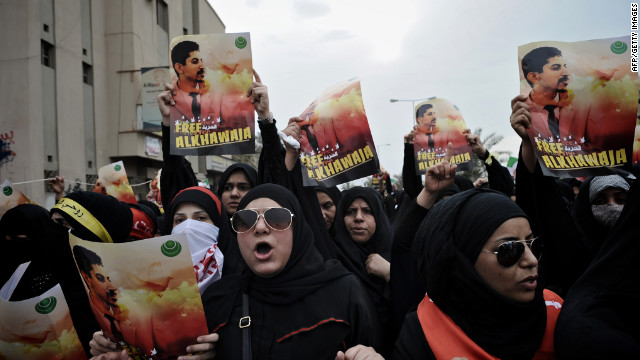
Although Fears Concerning Hunger Striker Were Quelled, The Situation in Bahrain Does Not Change

By Adom M. Cooper
Impunity Watch Reporter, Middle East

MANAMA, Bahrain–Activist Abdulhadi al-Khawaja has refused food since 08 February 2012 in protest of a life sentence he received in June 2011. He is a Shiite convicted by a military court of plotting against the Sunni-monarchy and is currently in a stable condition. Amnesty International stated last month that the trial was “grossly unfair” and that his conviction was based on a confession he made under duress, and no evidence was presented that showed he had used or advocated violence during the mass protests against King Hamad bin Issa al-Khalifa.

Bahraini Shiite protesters carry signs of al-Khawaja. (Photo Courtesy of CNN)

The nation of Denmark had asked Bahrain to send Khawaja, who is also a Danish citizen, to the Scandinavian country. Bahrain’s official news agency BNA reported on Sunday 08 April 2012 that officials in Manama had turned down the request.

On Monday 09 April 2012, Mr. Khawaja’s lawyer, Mohammed al-Jeshi, expressed fears that his client could have died after repeated attempts and requests to contact him were turned down. al-Jeshi shared these words with AFP on Monday 09 April 2012.

“We fear that he might have passed away as there is no excuse for them to prevent us from visiting or contacting him.”

The daughter of Mr. Khawaja, Zainab, told Al-Jazeera on Monday 09 April that the family had “no idea” about the state of her father’s health as they had not been allowed to call or visit him.

But on Tuesday 10 April 2012, al-Jeshi released a statement confirmed that his 52-year-old client was “in good health” and called on the media to exercise caution concerning the details of the situation. Two foreign doctors, one of them an expert on hunger strikes and the other the director of a medical center in Denmark, had visited the activist at the Bahrain Defense Force Hospital in the capital of Manama. Abdul Rahman al-Sayed, Bahrain’s attorney general, shared these words with a BBC correspondent.

“Despite prior medical reports that showed low blood sugar, potassium, and low white blood cells, which would have endangered his life if he had not received proper medical care, his current condition is well. He was co-operative, quite coherent, well-oriented in time, place and person, as he is receiving good medical care at the BDF hospital.”

Although Mr. Khawaja is in “good health,” the rest of his county is not. On 10 April 2012, seven Bahraini policemen were wounded when a home-made bomb exploded during a protest near the capital calling for the activist’s release. According to an interior ministry spokesman, demonstrators and protesters threw petrol bombs at riot police to lure officers into Eker, a Shia village outside Manama before the explosion was set off.

“We consider this an act of terrorism.”

Demonstrators and protesters have also revealed plans against hosting the Formula One grand prix, which was postponed last year. The race was reinstated to occur this year but was cancelled due to the uprising and bloody crackdown. The governing Internatonal Automobile Federation and Bahraini organizers have maintained that the race is still scheduled for 22 April 2012.

As Mr. Khawaja continues his hunger strike vigil with hopes to bring about change in Bahrain, one can only hope that government officials take stock in how effective demonstrators and protesters can be. The citizens of Bahrain are doing their best to be heard. It is up to the government to listen.


For more information, please see: 

Al-Jazeera – Policemen Injured in Bahrain Blast – 10 April 2012

BBC – Bahrain Hunger Striker Khawaja ‘In Good Health’ – 10 April 2012

Ahram – Jailed Bahrain Hunger-Striker Feared Dead: Lawyer – 09 April 2012

Al-Jazeera – Concern Mounts For Bahrain Hunger Striker – 09 April 2012

CNN – Bahrain Says Activist On Hunger Strike ‘Is Fine’ – 09 April 2012

The Guardian – Abdulhadi al-Khawaja’s Death Would Be A Stain On Bahrain – 09 April 2012


Ecuador Citizens March for Water, Life, and Dignity

by Emilee Gaebler
Impunity Watch Reporter

QUITO, Ecuador – President Rafael Correa recently signed a new mega-mining deal for the Mirador copper project with Chinese company Ecuacorrientes (ECSA).  Public outcry over this has been immediate with many citing the lack of environmental safeguards in the deal.

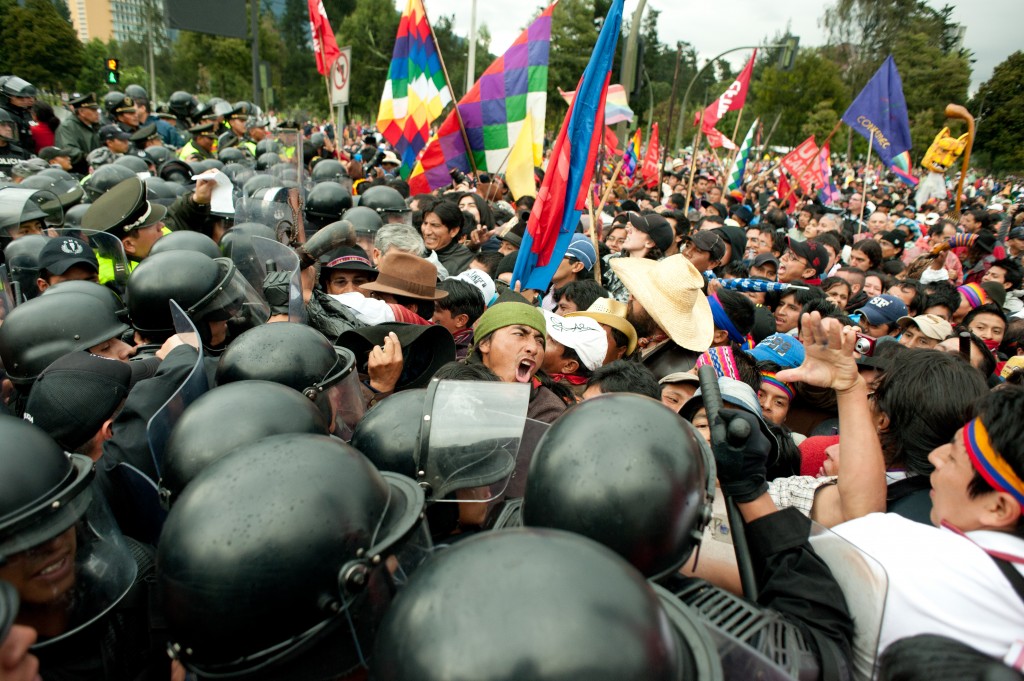
Some of the marchers clash with police as they enter Quito on March 22. (Photo Courtesy of McGill Daily)

Correa signed the deal and bypassed a number of national mandates regarding environmental protections.  The Mirador project is located in the Amazon province of Zamora Chinchipe, along the Peruvian border.  Correa failed to comply with Article 6 of the Ecuadorian Mining Mandate that regulates an established procedure for mining concessions granted on protected lands.

During the signing of the contract on March 5, Correa indirectly admitted that he was aware of the potential environmental damages the project posed.

“All mines pollute. We need mining. Let’s have responsible mining,” said Correa at the signing; while failing to mention that he was moving the project forwards without having done an Environmental Impact Assessment or obtaining an Environmental License.

Indigenous communities as well as other social activist groups throughout Ecuador came together the day after the signing to implement the March for Water and Life.  On March 22, the fifteen day march through Ecuador ended in Quito, the capital city.  At that point the march had close to 25,000 supporters.

Images of the march show that what started as a protest to the large-scale mining agreement, by the Confederation of Indigenous Nationalities of Ecuador (CONAIE), grew to include a number of wider issues facing the country.

“I am here in the spirit of solidarity between indigenous peoples and nationalities. Each people, each sector, has their own reason for being here. We, the Sapara Nation, are here to resist oil extraction on our land,” was one protestors comment regarding the growth of the march.

A 19 point charter was submitted to the government by the protest.  It covers a number of issues; including law of water, free admission to universities, equitable distribution of land, restoration of public servants, freedom of expression, and an end to open-pit mining and oil concessions.

The arrival of the march in Quito on March 22 was tense with large numbers of riot police on the streets and helicopters flying overhead.  Some isolated altercations broke out between the protestors and police at the end of the day.

Reports by local media are that President Correa paid people and gave them food and transportation to fill all public park spaces in Quito so that as the march entered the city protestors would have no place to gather.

For more information, please see;

Amazon Watch – Ecuador’s Indigenous People Reach Quito After 600 km March for Water, Life, and Dignity – 23 March 2012

Indigenous Peoples Issues and Resources – Ecuador March for Water and Life Video Report – 23 March 2012

The McGill Daily – Thousands Protest in Ecuador’s Capital for Water, Life, and Dignity of the People – 22 March 2012

FIDH – FIDH Calls for the Suspension of the First Large-Scale Open-Pit Mining Project in the Ecuadorian Amazon – 19 March 2012

Global Voices – Ecuador March for Water and Life Says No to Large Scale Mining – 17 March 2012

Latin America Press – Mega Mining Takes Off – 15 March 2012

Six Activists Detained in UAE

By Carolyn Abdenour
Impunity Watch Reporter, Middle East

DUBAI, United Arab Emirates – On Monday, 9 April, the authorities notified six activists they resided in the United Arab Emirates (“UAE”) illegally and detained them.  The authorities revoked the nationality of these activists for critical statements they made about the country’s leadership last year.

The UAE detained six activists after stripping them of thier nationality. (Photo Courtesy of Al Arabiya News)

The activists’ lawyer Mohammed al-Roken reported the Interior Minister summoned the activists to the capital Abu Dhabi to inform them they resided in the country illegally.  The Minister then instructed them to sign a statement that forced them to obtain a new nationality within two weeks.

Daughter of activist Mohammed Abdel-Razzaq al-Siddiq reported, “My father called us…He refused to sign the declaration as now he is stateless, so he was detained along with the other five men.”  The authorities detained the six in a detention facility that caters to illegal immigrants.

Al-Roken describes the government’s act of stripping the men of their citizenship as unconstitutional.

Al-Siddiq believes the authorities targeted them for advocating for political change as part of the Reform and Social Guidance Association, an Islamic political organization linked to the Muslim Brotherhood.  He sought political reform by signing a petition calling for the UAE leadership to grant more powers to the country’s Federal National Council, an advisory body.

Although the UAE has a generous welfare system and is a lead oil exporter, the leadership has aggressively quashed political dissent to maintain control of their country.  Last year, for example, the authorities detained an economics professor, a well-known blogger, and three other political activists on anti-state charges of endangering national security, inciting protests, and insulting the government.  A judge sentenced the detainees to two to three years in jail.  The president released the activists the following day, but he did not officially drop the charges.

On 5 April, the authorities detained representatives of the National Democratic Institute (“NDI”), a US-sponsored democracy group, when they attempted to depart the country once the authorities closed their UAE office for licensing issues.  After questioning an American employee in detention, the authorities allowed the two Americans to leave the country.  However, the authorities did not permit an employee of Serbian nationality to depart.

Authorities closed the NDI office on 28 March before closing the offices of Konrad Adenauer Foundation, a German pro-democracy group, on 29 March.  Polling group Gallup also recently closed its Abu Dhabi office.

Middle East researcher for Human Rights Watch (“HRW”) Samer Muscati commented, “It seems that the government is still frightened by the events transpiring in the Middle East and are trying to do what it takes to keep the Arab Spring from reaching its shore, regardless of how small that possibility might be.”

For further information, please see:

Al Arabiya News – UAE Detains Islamists Linked to Terror Funding – 10 Apr 2012

Gulf Daily News – UAE Activists Held – 10 Apr 2012

The Chicago Tribune – UAE Detains 6 Islamists Stripped Of Citizenship: Lawyer – 9 Apr 2012

The Kansas City Star – UAE Detains 6 Activists Critical Of Rulers – 9 Apr 2012

CNN – Details Emerge In UAE Closing Of Pro-Democracy Groups – 6 Apr 2012

Banda Sworn in as New Malawi President; Vows Reform

By Zach Waksman
Impunity Watch Reporter, Africa

LILONGWE, Malawi – Joyce Banda was sworn in as Malawi’s first female president on Saturday, a week after the death of President Bingu wa Mutharika, whose party expelled her after a disagreement over whether his brother Peter could succeed him.  The former vice president takes on the task of rebuilding a crumbling economy and restoring confidence in government.

“The first priority would be to revamp the economy and ensure that there is good governance,” said Banda.  “I know this is a great challenge but I thank all Malawians for having confidence in me.”

She took her first steps in that process on Monday, firing Police Inspector General Peter Mukhito.  Once hailed by Mutharika as the best IG Malawi ever had, Mukhito’s departure came as a surprise to some.  Banda’s administration did not provide an explanation, but his handling of recent events may have been a factor.  The country faced anti-government protests about the economy last July.  In response to the rallies, Malawian police fired into the crowds, killing at least 19 people.

Mukhito garnered fame for his questioning a lecturer about his comparisons between the Arab Spring uprisings and the country’s fuel crisis last year.  The incident escalated to the point that Chancellor College, part of the University of Malawi, was forced to close.  According to the People’s Party (PP) Orange Intellectuals, the youth wing of Banda’s political party, the conflict over academic freedom raged for eight months.  It welcomed the change in leadership.

“This could not have come at a better time,” said National Coordinator Edgar Chipalanjira, a student at the since-reopened Chancellor College.  “Honestly, it was hell under the former IG who was ironically dubbed ‘finest ever’ by the late President.  Those were the days no Malawian would wish to experience again.”

Banda has appointed commissioner Lot Dzonzi to replace Mukhito.

She will face a stiffer challenge on economic issues.  In the year before his death, Mutharika had a falling out with the United Kingdom, who cut off its aid to Malawi.  This has contributed to a shortage of foreign currency, as Mutharika also had poor relations with the International Monetary Fund and the World Bank.  Despite these hurdles, and her party’s lack of representation in Parliament, the government does not expect much political wrangling.

“We would like to help the new president to rebuild the country. Malawi at the moment is confronted by several challenges and the new needs support from lawmakers. By working with her, Malawians will benefit from development projects,” said an optimistic Ken Kandodo, the country’s former finance minister.  “We had [a] very smooth transition according to the Constitution. There were some people from the national governing council who wanted to disrupt this smooth process but have failed. We should all celebrate because democracy has triumphed.”

But government alone will not be enough to guarantee a successful turnaround.  Banda has emphasized the need to reestablish relations with foreign exchanges and to build up its own industries once again.

“The economy is on a downward spiral with challenges of availability of foreign exchange, fuel shortages and failure to pay civil servant on time or at all,” Banda said last May.  “The private sector is constrained to take an active role.  The country needs to urgently find alternative sources of foreign exchange.”

For more information, please see:

BBC — Malawi’s New President Sacks Police Chief Mukhito — 9 April 2012

Daily Times (Malawi) — Banda Tipped on Priorities — 9 April 2012

Daily Times (Malawi) — Industry Hopeful with New Regime — 9 April 2012

Nyasa Times — PP “Intellectuals” Hail Appointment of New Police Chief — 9 April 2012

Malawi Voice — Inspector of Police Mukhito Fired; Dzonzi Takes Over — 8 April 2012

New York Times — In Mourning, Malawi Swears in a New President — 7 April 2012