
By: Darby Glass
Journal of Global Rights and Organizations, Associate Article Editor
Creteil, France – On September 17th of 2026, the teachers, parents and students of Antoine de Saint-Exupery High School went on strike. The protestors refused to open the school and blockaded the entrance to prevent anyone from entering. Their demonstration was in response to staff shortages and a lack of educational resources, that especially affect poorer, immigrant-dense neighborhoods like Creteil.
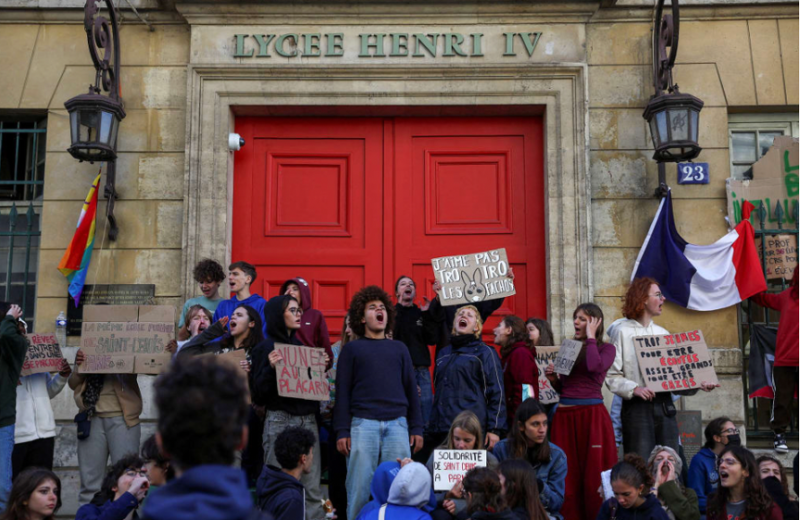
French students protesting outside of Henri-IV High School in Paris. Council on Foreign Relations, October 8, 2026. Photo courtesy of Reuters/Abdul Saboor.
In a matter of weeks, the unrest spread nationwide. On October 17th, more than 500,000 French citizens showed up to protest the teacher shortages, crumbling infrastructure, and overcrowded classrooms found throughout the country. What began in a smaller French suburb spread to major cities such as Marseilles, Lyon, Lille, Toulouse and Paris.
Although the first demonstrators were only concerned with issues within France’s education system, the cause’s expansion picked up other protestors’ issues along the way. The students were joined by climate activists and other French citizens frustrated with the cost of living. Instead of focusing solely on issues of education, the purpose of the unrest evolved into a general concern of what future the French government is creating for the next generation of young adult citizens.
As the demonstrations grew, so did the actions taken by said protestors, with some taking advantage of the mass unrest. Larger protests turned riotous, protestors hurled glass bottles and fireworks at police officers, while others set fire to cars and boutique stores.
The French police force responded in kind. During larger demonstrations riot police fired tear gas and volleys of stun grenades back into the crowds. Between September 28 and October 5, over six thousand people were arrested and another five thousand were detained-most under the age of 18. In reaction, both local and national authorities put in place both curfews and local bans on protests.
In a statement released on October 28, the United Nations Officer of the High Commissioner condemned the violence and mass arrests conducted by the French police force. Specifically, UN experts designate the excessive force as an inappropriate response by a state that is governed by the EU rule of law.
The students’ and teachers’ demands have yet to be met, and the demonstrations continue into November. French authorities have doubled down on their punishments of the demonstrators. On November 4, in an accelerated procedure, French senators backed the “Rioters Pay” bill. The bill would require protestors to pay up to $10,000 euros to pay for damages caused by the more violent demonstrations.
The French Government’s endorsement of police violence against the country’s protestors questions whether this administration is committed to upholding the French constitutional right to protest and its obligations as a member-state of the European Union.
For further information, please see:
The Guardian – French pupils resume school blockades as country braces for more protests – 2 Nov 2026
NPR – France seethes again as youth-led protests sweep Europe – 31 Oct 2026
CNN World – Hundreds of thousands march in largely peaceful protests across France – 5 Nov 2026
Council on Foreign Relations – What’s Behind the Protests and Riots in France, and What Comes Next – 28 Oct 2026
CNBC – French Senate backs ‘Rioters Pay’ bill that could make protesters pay $11,000 fines – 29 Oct 2026
United Nations – France: UN experts appalled by crackdown on student protests – 28 Oct 2026
Courthouse News Service – France passes controversial ‘Rioters Pay’ bill while students push for reforms – 28 Oct 2026
