By: Jocelyn Anctil
Impunity Watch News Staff Writer
NUEVA SAN SALVADOR, El Salvador – On October 6, 2025, the Inter-American Court of Human Rights received a submission to hear Case 12.787, Natividad de Jesús Ramírez and Family v. El Salvador. This case arises from the extrajudicial killings and forced disappearances of several Ramírez family members in 1982, after they were labeled subversive enemies during El Salvador’s civil war, when the military government targeted Catholic Church activists as communist threats.
During El Salvador’s internal armed conflict (1980-1991), the Ramírez family was active in the Catholic Church which subjected them to raids, threats, arrests, and assaults by public state officers. In 1982, state forces killed Rufino and Teresa Ramírez, while five other family members, Natividad de Jesús Ramírez, Salvador Ramírez, José Elías Ramírez, Jorge Alberto Ramírez, and Guadalupe Roble, were forcibly disappeared and their whereabouts remain unknown today.
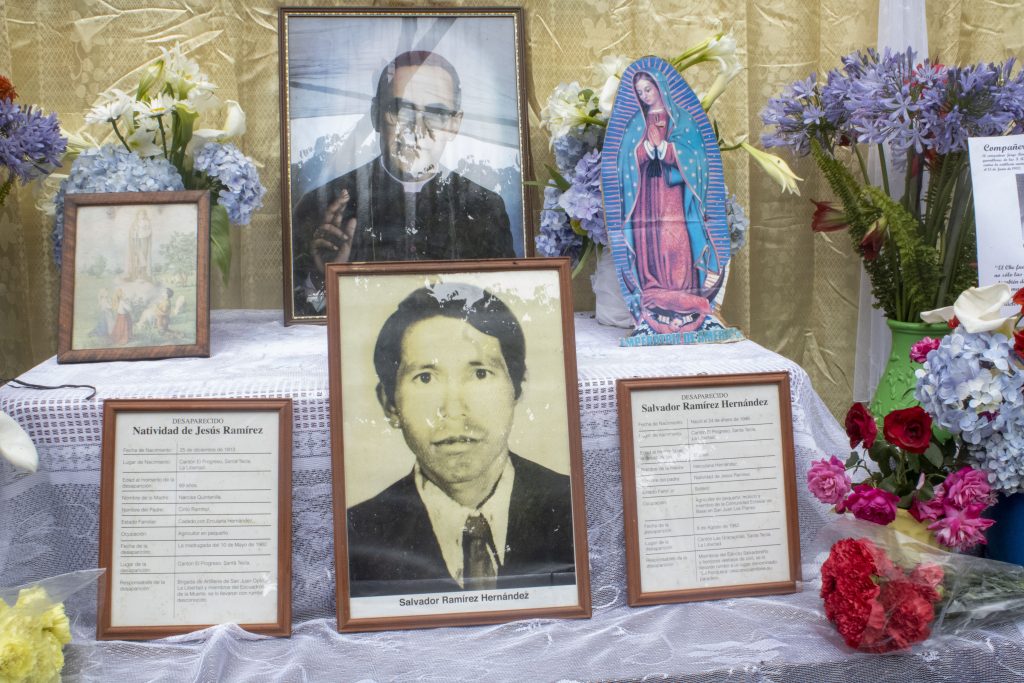
Since then, the Ramírez family has made numerous efforts to find answers and bring justice to their family, including seeking assistance from the Attorney General of El Salvador and the Inter-American Commission. The Commission launched an investigation and concluded that El Salvador is responsible for violating multiple rights of the victims, including their right to life in Merits Report 150/23. The Merits Report was sent to El Salvador and after efforts to reach a settlement failed, the Commission submitted the case to the Court.
The victims’ family wants the truth about what happened to their loved ones and accountability for their loss. They claim, and the Commission found, that El Salvador failed to investigate, preserve crime scenes, perform autopsies, or conduct effective searches. The Commission’s recommendations urge the Court to order El Salvador to investigate disappearances, identify remains, provide healthcare to relatives, pursue criminal investigations with gender perspective, and adopt non-recurrence measures like DNA databases and accession to the Inter-American Convention on Forced Disappearance of Persons.
Although the Inter-American Court of Human Rights has yet to decide whether to accept the case, doing so would give the Court an opportunity to clarify the standards of investigation and specialized procedures required of each state when cases involve disappeared persons.
This case represents the challenge of holding El Salvador’s government for what occurred during the civil war, during which an estimated 75,000 civilians were killed or forcibly disappeared, with 85% of violence committed by state forces according to the UN Truth Commission. El Salvador’s amnesty law, which blocked prosecution of civil war atrocities, was struck down by the Inter-American Court in 2012 and invalidated by El Savador’s Supreme Court in 2016. However, investigations into civil war crimes have remained stagnant with many cases still in impunity decades later.
For Further Information Please See:
El Salvador: Tackling Impunity Past and Present – Inter-American Dialogue
