ECHR Says UK Bedroom Tax Violates Occupancy Rights of Gender-Based Domestic Violence Victims

By: Mujtaba Ali Tirmizey

Impunity Watch Staff Writer

LONDON, England — On October 24, 2019, the European Court of Human Rights (“ECHR”), in a highly significant decision, held that a reduction in housing benefits based on occupancy violated Article 14 (Prohibition of Discrimination) and Article 1 of Protocol No. 1 (Protection of Property) in relation to domestic violence victims.
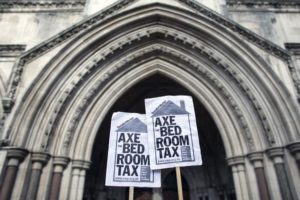
The UK Government has been ordered to pay “A” 10,000 Euros. Photo Courtesy of Getty.

“A”, a British national, was a victim of rape, assault, harassment, and stalking at the hands of her ex-partner. She was living in a “Sanctuary Scheme” home – properties specifically designed to enable women and children in grave risk of domestic violence to live securely in their own homes – with her 11-year old son. The adaption to the three-bedroom house included the installation of a “panic room” in the attic for herself and her son.

In 2013, new rules on housing benefits in the social housing sector, more commonly known as the “Bedroom Tax,” reduced the benefit by 14% for people with a “spare” room in their home. Proponents of the new rules claimed that the Bedroom Tax was designed to free up much-needed bigger homes. Since “A” and her son were living in a three-bedroom house, their housing benefit decreased as a result. “A” challenged the Bedroom Tax, contending that the reduction in the benefit put them in unstable circumstances, which were not remedied by other payment schemes. The UK Supreme Court dismissed their claim and they appealed to ECHR in 2017 on the basis of gender discrimination as the victim of gender-based violence, relying on Article 14.

The Court noted that “A” and her son would face hardship and a risk to personal safety if they had to move. The Court then stated that the regulation’s aim to urge people to move was in conflict with the Sanctuary Scheme’s goal of allowing victims of gender-based violence to stay in their homes. The progress of gender equality is a major goal for the member States and “very weighty reasons” must be provided before gender discrimination could be considered lawful.

Here, the Court determined that treating all people in Sanctuary Schemes in the same manner was disproportionate as it did not relate to the legitimate aim of the measure. The Government failed to offer any weighty reasons to rationalize prioritizing the aim of the Scheme over that of enabling victims of domestic violence to stay in their homes. Therefore, the Court held that “A” had endured a violation of her rights under Article 14 in conjunction with Article 1 of Protocol No. 1.

In the aftermath of this decision by ECHR, lawyers have demanded action on nearly 300 women estimated to be in similar situations. As the vast majority of those in the Sanctuary Scheme are women, this decision will help limit gender-based and domestic violence victim discrimination. This ruling is significant not only because it over-turned a troubling UK Supreme Court decision, but this ECHR ruling can potentially favorably impact other domestic violence victims in similar situations in other member states.

For further information, please see:

24housing – European Court Lands Blow on the ‘Bedroom Tax’ – 25 Oct. 2019

European Court of Human Rights – New UK Housing Benefit Regulation Discriminated Against a Woman Who Had Suffered Domestic Violence – 24 Oct. 2019

American Society of International Law – European Court of Human Rights Holds UK “Bedroom Tax” is Discriminatory – 24 Oct. 2019

Mirror – DWP Bedroom Tax Dealt Defeat in European Court of Human Rights – 24 Oct. 2019
After a U.S. Agent Killed a 15-Year-Old at the Border, the Supreme Court Will Decide If He Can Be Sued in Federal Court

By: Dianne Jahangani

Journal of Global Rights and Organizations, Associate Articles Editor

WASHINGTON D.C. – On November 12, the U.S. Supreme Court will decide whether a government officer can be brought before a federal court for violating a foreigner’s constitutional rights when the act took place on foreign soil.

On July 7, 2010, a young 15-year-old national of Mexico, Sergio Adrián Hernández Güereca, was playing on the Mexican side of the border, unarmed and unthreatening when an U.S. Border Patrol agent, Jesus Mesa, shot Sergio twice, ultimately killing him.

As a result, Sergio’s parents, on behalf of Sergio, brought this lawsuit against Mesa. However, Mesa claimed immunity as a government officer at work, stating that Congress had not created laws which assign liability to agents as well as stating that those killed on foreign soil cannot sue American officers. Yet, the case is not that simple, as the young boy was shot across the border and Mesa discharged his weapon while on American soil. This creates an interesting legal issue and calls into question the scope of the U.S. Constitution.

To date, the Department of Justice has concluded that there was insufficient evidence to prosecute under a federal homicide charge and that prosecutors lacked jurisdiction because Hernández was neither within the borders of the U.S. nor present on U.S. soil.

Despite the DOJ’s initial decision, the plaintiffs asserted that Agent Mesa used deadly force without justification against Sergio Hernández, thus violating the Fourth and Fifth Amendments. On behalf of the Hernández parents, the Institute for Justice filed an amicus brief urging the U.S. Supreme Court to allow the parents of Sergio to sue the federal officer in federal court stating the following:

“The Fourth Amendment protects citizens against the arbitrary use of deadly force at the border, at least in the context of a close range, cross border shooting in a confined area patrolled by federal agents.”

After waiting several years, on November 12, the plaintiffs will finally have the ability to present their case to the U.S. Supreme Court. Although this is certainly a legal victory for the Hernández family, they are still fighting an uphill battle, since lower courts have previously ruled against the family:

“The Hernandez family argues that Mesa violated their son’s Fourth Amendment right to be free from unconstitutional governmental searches and seizures, his death being the ultimate seizure. But the Fifth Circuit interpreted the prior precedent to preclude the Mexican parents from suing, citing special factors like national security, law enforcement, and diplomatic relations as concerns.”

Even if the Supreme Court disagrees with the lower court’s findings and rules in favor of the Hernández family, the family must still make the argument that the agent violated their son’s constitutional rights. This ultimate ruling will have far reaching consequences as it will effectively extend the scope of the Constitution to outside the U.S. borders.

The decision rendered in this landmark case will ultimately determine the scope of the U.S. Constitution and power delegated to U.S. agents at the borders and national security.

For further information, please see:

Quartz – A US border patrol agent killed a child in Mexico. Can the parents sue him? – 26 Oct. 2019

Institute for Justice – U.S. Supreme Court Will Decide: May Parents of a Mexican Teen Killed by a Federal Officer Sue in Federal Court to Vindicate Their Son’s Rights – 25 Oct. 2019

ABC News – Supreme Court hears case of teen shot dead in Mexico by border agent in US – 21 Feb. 2019

U.S. Supreme Court – Hernandez v. Mesa – March. 20 2018

 NPR – Mom of Cross-Border Shooting Victim ‘Still Waiting for Victory’ – 27 June. 2017

The New York Times – An Agent Shot a Boy Across the U.S. Border. Can His Parents Sue? – 17 Oct. 2016

Read the Petitioners’ Brief Here.

Egyptian Authorities Crackdown on Anti-Government Protestors

By: Alexandra Casey

Journal of Global Rights and Organizations, Associate Articles Editor

CAIRO, Egypt — On September 20, 2019, anti-government protests were held in several Egyptian cities, violating the country’s ban on protesting without a permit. Protesters called on President Abdel Fattah al-Sisi to step down following allegations of government corruption. Egyptian authorities have since detained more than 2,000 people in a government crackdown. This response is significant even in a regime that has long targeted dissenters.

Protestors in Cairo, Egypt. Photo Courtesy of NPR.

According to Amnesty International, authorities have arrested everyone from street protestors to prominent government critics and have accused detainees of breaking the country’s broad anti-terrorism laws, spreading fake news, protesting without a license, and joining an illegal organization. Many of the arrests appear to have no connection to the recent protests. After September 20, al-Sisi moved swiftly to rally support. He organized state backed demonstrations praising his current rule and had authorities set up check points to search all cell phones for signs of government criticism.

Prominent journalist and activist, Esraa Abdelfattah, was reportedly arrested by plain-clothes officers and beaten after refusing to unlock her cell phone. Aaron Boehm, a U.S. citizen who had recently arrived in Egypt for a University of Edinburgh study abroad program, was also detained after police officers stopped him in the street and searched his phone. Upon discovering that Boehm sent articles to his friends about the protests, he was put in a vehicle, blindfolded for about 16 hours and interrogated by authorities. While Boehm did not suffer physical abuse, he reported seeing signs of violence against detainees.

The sheer volume of arrests following the September 20 protests combined with al-Sisi’s meager gestures towards addressing citizens’ economic grievances suggest that while Egypt appears stable, unrest may lie just below the surface. Analysts say that al-Sisi’s promise to reinstate subsidies for staples such as rice and pasta will do little to rectify citizens’ disapproval.

Mass arrests have resulted in overcrowding of detention centers, and allegations of torture and ill treatment in detention centers has received attention from the United Nations Human Rights Office. The UN High Commissioner for Human Rights, Michelle Bachelet, has also expressed concerns about significant due process violations.

In a statement to press, OHCHR spokesperson, Ravina Shamdasani, reminded the Egyptian government that “under international law people have a right to protest peacefully, and a right to express their opinions, including on social media. They should never be arrested, detained – let alone charged with serious offences such as terrorism – simply for exercising those rights.”

Shamdasani called for immediate release of those who have been arrested and detained solely for exercising their rights and prompt, effective investigation into the allegations of torture and mistreatment.

For further information, please see:

Reuters – U.N. rights office urges Egypt to free blogger, lawyer, journalist – 18 Oct. 2019

UN News – UN human rights office urges Egypt to immediately release detained protestors – 18 Oct. 2019

NPR – Major Crackdown In Egypt Sweeps Up Activists, Children and At Least 1 U.S. Citizen – 12 Oct. 2019

NY Times – Egypt’s Harsh Crackdown Quashes Protest Movement – 4 Oct. 2019

Reuters – More than 1,100 detained in Egypt after protests: rights monitors – 25 Sept. 2019

Human Rights Court Finds Holocaust Denial Not Protected Under Freedom of Expression

By: Mujtaba Ali Tirmizey

Impunity Watch Staff Writer

BERLIN, Germany – On October 3, 2019, the European Court of Human Rights (“ECHR”) held that denying the Holocaust happened is not protected expression under Article 10.

Udo Pastörs being arrested by police following a far-right demonstration in May 2012. Photo Courtesy of the Reuters/Fabien Bimmer.

On January 28, 2010, the day after Holocaust Remembrance Day, Udo Pastörs, a far-right politician, a member of Parliament and chairperson of the National Democratic Party (“NDP”) of Germany at the time, delivered a speech in which he declared that commemorations of the Holocaust were “theater” and claimed that “the so-called Holocaust is being used for political and commercial purposes.” In August 2012, he was convicted by the district court for violating the memory of the dead and intentional defamation of the Jewish people. Subsequently, his appeals to the regional court, the Court of Appeals and the Federal Constitutional Court were also rejected. After exhausting all his remedies in Germany, Pastörs filed a complaint with the ECHR in 2014.

The Court firmly rejected Pastörs’ claim that his statements were protected under Article 10 of the Convention, which protects freedom of expression. The Court emphasized that Pastörs had planned his speech in advance and intentionally chose his words while denying the Holocaust, contradicting established historical facts, and exhibiting disdain to its victims. The Court further noted that while an interference with freedom of speech over statements made in a Parliament warranted close scrutiny, these specific statements deserved little protection, if any, given that they were at odds with the democratic values of the Convention. In addition, this case also had to be analyzed in the context of the special moral responsibility of States which had experienced Nazi horrors.

Ultimately, the Court held that Pastörs had deliberately stated lies in order to defame the Jewish people and the oppression they had endured. Therefore, the conviction by the domestic courts had been proportional to the goal pursued and was an essential decision in a democratic society.

Interestingly enough, Pastörs, who is a clockmaker by trade, had previously run into trouble with the German authorities as well. In 2010, he was convicted of treason for calling Turkish-German men “semen cannons” and for referring to Germany as a “Jew Republic.” He also referred to famous American economist, Alan Greenspan, as a “hooknose.”

The NDP was founded by the supporters of the former Hitler regime and has an extensive history of being rallying point for new generations of German Nazis. The party has consistently failed in local and national elections and has been unable to make a significant impact in the European Parliament. If their chairperson had not been disciplined for his remarks in the Parliament, the NDP could have gained some momentum. However, the ECHR and the domestic courts correctly determined that the freedom of expression defense was ill-founded in this scenario.

For further information, please see:

The Algemeiner – Denying Holocaust is not a Human Right, Eu Court Determines in Ruling Against German Neo-Nazi – 4 Oct. 2019

Courthouse News Service – Court Rules Holocaust Denial Not Protected by Rights Law – 3 Oct. 2019

European Court of Human Rights – Holocaust Denial is not Protected by the European Convention on Human Rights – 2 Oct. 2019

European Court of Human Rights – Pastörs v. Germany – Oct. 2019

Belfast Court Finds Abortion Ban Violates Human Rights Obligations

By: Hannah Gabbard

Journal of Global Rights and Organizations, Associate Articles Editor

BELFAST, United Kingdom — On October 3, 2019, the High Court in Belfast ruled that the abortion law in Northern Ireland, which banned abortion in all cases except when a mother’s life is at risk, violated Article 8 of the European Convention on Human Rights (“ECHR”). Under the abortion law in Northern Ireland, rape, incest, or a diagnosis of fatal foetal abnormality (“FFA”) are not grounds for a lawful abortion. 

Sarah Ewart, left, leaves the Belfast High Court. Photo Courtesy of CNN.

In 2013, Sarah Ewart, the applicant, travelled to England to terminate her pregnancy after an ultrasound scan at 20 weeks revealed that Ewart’s baby would either die before or shortly after delivery. Ewart was denied an abortion under the law even though her pregnancy was a case of FFA. Due to the law, Ewart was not allowed to bring the remains of her daughter back into Northern Ireland to allow for an autopsy. Ewart claimed that legislation preventing an abortion in cases of FFA violated domestic, human rights and international law and was incompatible with Article 8 of ECHR which guarantees the right to respect for private life. Additionally, she challenged the Departments of Justice and Heath for failing to implement measures to comply with Article 8 of ECHR.

Ewart brought the case after a United Kingdom Supreme Court judgement in June 2018 found that Northern Ireland’s abortion law was inconsistent with the United Kingdom’s obligations under Article 8 of ECHR. The UK Supreme Court could not attach a declaration of incompatibility to the law because the original applicant, the Northern Ireland Human Rights Commission, was not a “victim” of any unlawful act. In Ewart’s case, Justice Siobhan Keegan followed the ruling from the UK Supreme Court that the law was incompatible with human rights. In following the ruling, Justice Keegan’s judgement concerned whether Ewart had standing and if so, whether declaratory relief would be appropriate. 

Justice Keegan found that Ewart had standing because she had to travel to seek an abortion due to the current law and she is at risk to be affected by the law in the future because of her continued risk to have a baby with FFA. Further submissions to the court are required before Justice Keegan will decide on an appropriate relief. 

Abortion rights are highly contested in Northern Ireland due to the religious influences of the Protestant and Catholic communities. Pressure to ease the abortion restrictions had mounted in Northern Ireland after Ireland voted to end the constitutional ban on abortion in May 2018. 

The implications of this ruling are uncertain in Northern Ireland due to the simultaneous legislation proposed in the British Parliament. In 2017, Northern Ireland’s regional government became decentralized when a power-sharing agreement between Protestant and Catholic political parties failed. In July 2019, United Kingdom legislators voted for the Northern Ireland to decriminalize abortion and extend same-sex marriage if the regional government is not restored by October 21. 

This ruling in Northern Ireland contributes to the larger conversation on abortion rights internationally. In the United States, President Trump introduced international version of the “gag rule”  in 2018 where international health clinics that either provide or refer women to abortion services are no longer permitted to receive US development funding. The restriction of abortion services push women to seek abortion in dangerous settings or, in the case of Sarah Ewart, travel overseas to access an abortion.

While acknowledging the pending legislative action in her judgement, Justice Keegan stated that the prospect of upholding the abortion ban would not “serve any benefit” or “be right to ask another woman to relieve the trauma these events undoubtedly cause.” 

For further information, please see:

BBC – Northern Ireland abortion law found to breach human rights – 3 Oct. 2019

CNN – Northern Ireland abortion law breaches human rights, high court rules – 3 Oct. 2019

Judicial Communications Office – Court Delivers Abortion Legislation Judgement – 3 Oct. 2019

Reuters – Court rules Northern Ireland abortion ban violates UK human rights commitments – 3 Oct. 2019

CNN – Women in Northern Ireland to get access to abortion services in Republic – 15 Nov. 2018